Posts Tagged ‘Catalonia’

Tour du Valier: walking on the edge

Friday, August 16th, 2024

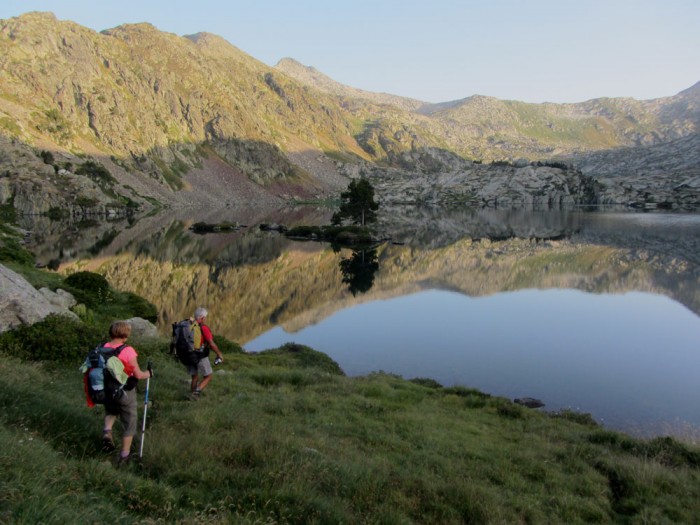
The Tour du Valier is a six-day wander in the high Pyrenees, with five nights in refuges. Automatically, you have less weight in your rucksack.

The terrain varies from bucolic to harsh, from nearly flat to steep; there are short sections secured by cables. Underfoot, the going varies from mud, through grass, to hard unforgiving rock. There is a destabilising field of scree north of the Col de la Pala de Clavera on the Catalan/French border, requiring attention.

Seix

Seix seen from the small hill to its north (access via the chateau)

Before starting, I spent the night in Seix, a large village with many facilities. The chateau is worth a visit, if only to see the exhibition on the ibex. Another possibility, if you have time to spare, is the fascinating Museum des colporteurs in Soueix.

Ibex in a museu,

One of the ibex in the exhibition

The last member of the Pyrenean sub-species died in 2000 but there have been new arrivals from Spain since 2014. These Iberian cousins are doing well, with about 650 in the mountains now.

River Salat with the Port de Salau in the background

I left my car in the carpark above Salau (see Navigation, below) and followed the river Salat up to its source. Salat means salty: the mountains here are full of minerals. The border with Catalonia is on the horizon. It is long but easy trek with 1100m of climbing.

There are bears here. Although they are rarely seen, they attack livestock, sheep in particular. The estive (summer pastures) of Pouilh at the head of the valley saw two sheep attacked a few days after I passed through. It seems to me that sheep are gradually being replaced by cows and horses, less susceptible to attacks.

However, the chances of meeting a bear are very low. I have been walking in the Pyrenees for 25 years and haven’t seen one yet.

The Port de Salau

The Port (pass) de Salau was a key link between Ariège, in France and Pallars Sobira in Catalonia. It is only 2087m above sea level and was frequented by travellers and merchants. Among them were the colporteurs who walked long distances to sell a wide variety of wares which they carried on their backs.

Path down from the Port de Salau to the Fornet refuge

In the XIX century the Bonabe forest on the Catalan side of the watershed was cut down and the wood exported to France on a cableway. The ruins on the pass date to that time.

Fornet refuge

The Fornet refuge is accessible by road, which makes it another possible starting point for the Tour du Valier. Opposite it is a display panel which explains the reintroduction of bears in the Pyrenees.

Path in mountains

Path from the Bonabé valley to the Estagnous refuge

As elsewhere, the path is signalled with the red-and-white waymarks of the Grande Randonnée Transfrontalière. Here, the waymarks are accompanied by yellow ribbons, a symbol of the Catalan independence movement.

cows by a lake

Cows happily graze at the Estanyet de Clavera, 2230m above sea level


The view on the other side of the Coll de la Pala de Clavera is daunting. It is a long way down.

The path passes to one side of the Lac Long and then down to the Lac Rond before climbing up again to the next refuge. There is much scree to be negotiated carefully. The snow patches were actually a relief!

Hostel on hillside

The Estagnous refuge, above the Lac Rond


sitting at a table after dinner

After dinner

After dinner, the clouds descended but it was still warm enough to sit outside. A welcome relief from the overbearing heat of the day.

landscape

Lauzets

After staying overnight in the Estagnous refuge, I climbed up to the ridge behind the building. Beyond the ridge is an area known as the Lauzets, the Occitan for small slabs or tiles. The slope is covered in stone, but it is easy walking. This is part of the Chemin de la Liberté.

landscape

Further along the ‘lauzets’ are interspersed with grassy patches.

The descent to the Lac de Milouga is steep but provided with metal steps on the more difficult sections.


The path climbs to the pass on the left


There are shepherd’s huts at intervals but little other sign of life apart from the livestock. I met nobody until I arrived at the Cabane de l’Échelle

Down below, the clouds were a welcome relief from the implacable sun. It was great to see the Esbintz refuge. Adeline, who runs it, is also a market gardener and her partner Mathias is a sheep farmer. So, the food mostly comes from the farm itself. The recipes, on the other hand, may come from anywhere. Delicious.

Walker's hostel on GR10

Esbintz

The next day, the path followed the Tour du Biros. Part of it is on an exposed slope. The path is non too wide.

In the forest

Then it delves back into the forest before descending to Saint-Lizier-d’Ustou and the Colline verte refuge. The rain started mid-afternoon and quickly developed into a storm. (By the way this is a commen weather pattern in summer. Aim to arrive at the refuges by 16h00.)

goats in a shed

Goats at Rouze, after milking

The next day was overcast and damp at first, but not rainy. The Rouze hostel is another great farm stay.

mossy path

Path down to Couflens


Couflens

Navigation

You can begin where you like but the classic starting point in France is the carpark at the Col de Pause, to the west of Couflens on the GR10. Unfortunately, there is now a barrier 5km away, so I decided to start my itinerary from the carpark above Salau. From there, the itinerary goes over the Port de Salau and down to Fornet. The next day will take you to Estagnous, with the possibility of climbing to the summit of Mont Valier (2828m). On the following nights, you will stay at Esbintz, the Colline verte and Rouze. From Rouze down to Couflens is an easy walk. I hitched back up to the carpark with no difficulty.

See Wikiloc for a GPS track of the Tour du Valier. There is also a series of GPS tracks of the Tour du Valier for each day, with more photos.

Anti-bear group softens its stance on reintroductions

Thursday, September 14th, 2017
European brown bear

European brown bear (photo: © Francis C. Franklin, Wikipedia)


The ASPAP* is no longer demanding that bears be removed from the Pyrenees. The association, set up in January 2006 to protest at the second wave of reintroductions of bears from Slovenia, had been unwavering in its stance. But despite the recent loss of 209 sheep following an attack in the high Ariège it has now has officially changed its stance.

(more…)

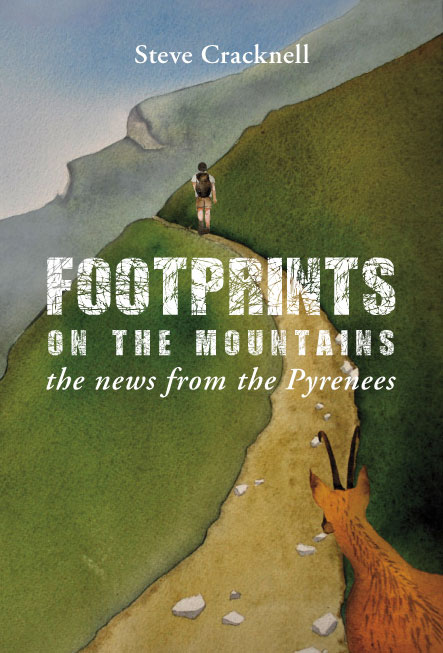
Footprints on the mountains… the news from the Pyrenees

Monday, May 2nd, 2016
Footprints on the mountains... the news from the Pyrenees

Footprints on the mountains… the news from the Pyrenees

My new book on the Pyrenees and walking

From the back cover: The Pyrenees are by turns beautifully natural and bleakly austere; shaped by centuries of labour… and scarred by human suffering. In the valleys, Steve talks to locals and meets an eccentric cast of hikers. But on the heights he is alone with marmottes and sarrios. He listens to protagonists on both sides of the argument over the reintroduction of bears. And goes searching for ibex imported as part of a rewilding programme.

Sario (Spanish) or isard (French), a common sight in the Pyrenees

Sario (Spanish) or isard (French), a common sight in the Pyrenees


My new book on the Pyrenees is about to be published. This time I’ve been walking on the Senda Pirenaica, the GR11.

(more…)

21st-century Pyrenees (iii): on ice and water

Monday, March 14th, 2016

The Pyrenees are changing. This is the third in a series of articles on the mountains in the 21st century.


Rhododendrons and broom in the Grava valley on the GR10

Rhododendrons and broom in the Grava valley on the GR10


The foothills of the Pyrenees are evolving, with pastures, no longer in use, being invaded by rhododendrons and gorse. It may well look pretty but it is a sign of decay. Higher up, decay is also evident.

(more…)

21st-century Pyrenees (ii): border crossings

Tuesday, February 23rd, 2016
Romedo de Dalt on the new chemin des Montagnes de Liberté

Romedo de Dalt on the new chemin des Montagnes de Liberté


Seen from a distance, the Pyrenees are timeless, an archetype of what mountains should be. But I recognise how much my personal travelogue is full of romantic clichés. So I’ve been thinking about the reality: the ‘news from the mountains’. This is the second in a series of close-ups on how the Pyrenees are changing.

Putting aside the TGV high-speed train (2013) and the THT high tension electricity cable (2015), thankfully both underground, what is the other news?

Way of St James
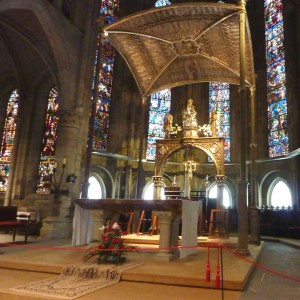
Church in Roncevaux

Church in Orreaga/Roncevaux

The Way is no longer a just a long-distance walk; it has become a social phenomenon. Since the turn of the century the number of walkers crossing the Pyrenees on the Way has increased more than five-fold. This leg of the walk, from St-Jean-Pied-de-Port (France) to Orreaga/Roncevaux (Spain) is reputed to be one of the hardest of the trek. In 1999, 9,318 walkers had their credencial (pilgrim passport) stamped in the French office before setting off. Fifteen years later they were 53,972. [Statistics] If that figure doesn’t surprise you, consider this one: in 1978 only 13 pilgrims crossed the threshold of the cathedral in Santiago. [Historical statistics] Nobody in St-Jean-Pied-de-Port was even bothering to count.

Passing through the town once, I asked a man in the office why so many more people had taken it into their heads to walk the 800km. It isn’t that people have become more religious, he replied. It is partly the inclusion of the Way on the World Heritage List (1993), partly the shorter working week in France (2000), and partly a snowball effect: more walkers means more hostels, means shorter days, bringing in even more walkers. (more…)

Mountains of Freedom – a four-day circular trek in the Pyrenees (Ariège and Catalonia)

Sunday, August 23rd, 2015
Cascade-d'Ars near to Aulus-les-Bains

Cascade-d’Ars near to Aulus-les-Bains


Official site of the Mountains of Freedom walk.

This circular walk in the central Pyrenees takes in rugged high mountain passes, pristine lakes and peaceful farmland. But behind all the beauty lies another story, intimately linked to the history of the 20th century and its refugees. Just like those who cross the Mediterranean today, many failed to arrive at their destination. Today, climbing up to the passes is a pleasure but the interpretive panels tell a different story.

We took four days, staying in staffed hostels each night.

Aulus to Bidous (Gîte de l’Escolan) 5h30

There is a restaurant half way along this section at 1700m, the Chalet de Beauregard; at the end, the gîte d’étape “l’Escolan” run by Pauline and Jean-Charles provides a warm welcome.


Gîte de l’Escolan at Bidous

Gîte de l’Escolan at Bidous

(more…)

map of GR10

 
site designed by Archétype Informatique: création de site internet, Narbonne