


French Pyrenees GR 10 trail: a walker’s guide
Cet article est également disponible en: French

On Hendaye beach – at the start of the GR10
What equipment do you need for walking the GR 10 across the Pyrenees, how long does it take, which are the most interesting sections? Here are my answers. If you don’t find what you are looking for fill in the comment form at the bottom and I’ll try to help.
This is not meant to be a definitive guide to the GR10 – it is very much my personal advice. I believe that Traveling Light is the Only Way to Fly. It also saves on the knees and shoulders. And I am prepared to pay the cost of staying in hostels rather than camping. It would be great to have other comments and suggestions…
For a quick overview of the route see the section on navigation below. The Wikiloc maps show both the route and the (saw tooth) profiles.
Updates on GR10 diversions
The FFRP (French Rambler’s Association) in the Pyrénées-Atlantiques has a page dedicated to changes in the route of the GR10. But as far as I can see the Ariège committee is no longer producing its equivalent.
What is the attraction?
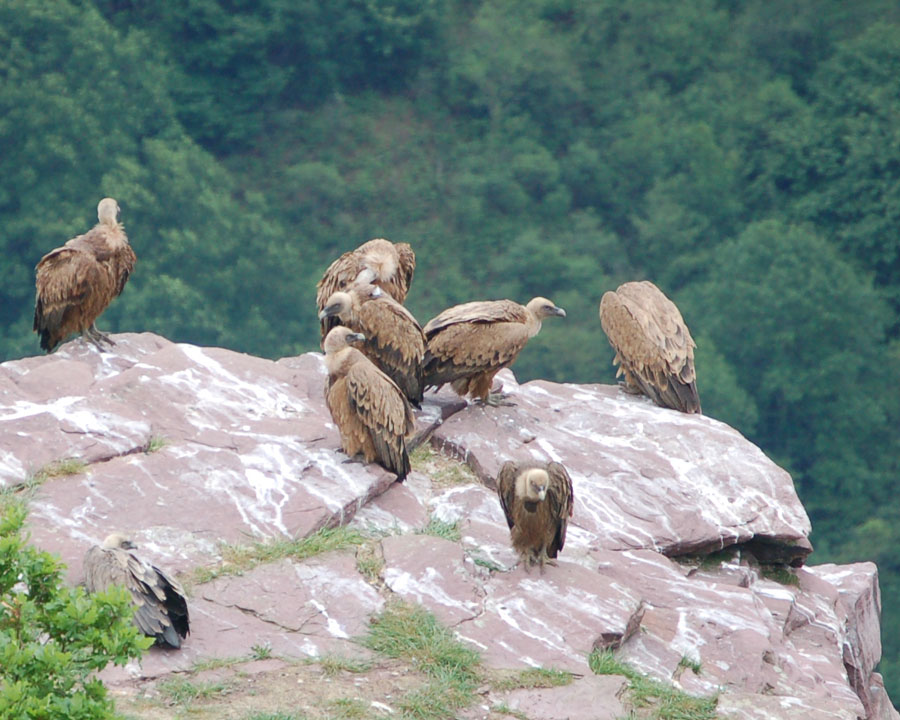
Griffon vultures
The GR 10 is a classic mountain walk, large scale. It crosses France from one side to the other, links the Atlantic to the Mediterranean, and takes a whole range of mountains, the Pyrenees, in its stride.
The western end is lusciously green, the middle austere and rocky, but as the Mediterranean approaches, dry garrigue and blue skies take over. The walk visits all the well-known sights of the range – the Lac de Gaube, the Lac d’Ôo, the Cirque de Gavarnie – and nestles up to some of its highest mountains. One of them, the Vignemale (3295m), an optional extra involving crossing a glacier, can be tackled in a single memorable additional day (see below).
And yet, despite the sometimes rugged terrain, there are hostels to be found most evenings; the GR 10 combines days in natural surroundings with nights under a solid roof.
Hendaye to Banyuls or Banyuls to Hendaye?

Bidarray in the Basque country
It’s not the same. Most people walk from Hendaye on the Atlantic coast to Banyuls on the Mediterranean, probably because the official French guide and Paul Lucia’s guide are written like that. As there are only a limited number of hostels, this means you keep bumping into walkers met along the way – conviviality assured. Walking in the other direction must be a completely different experience, with more interaction with nature than with other walkers
How long does it take to walk the GR 10?
Typically between 45 and 60 days of walking 6-8 hours a day. Plus rest days. Plus a few days more if you follow one or other of the variants.
What is the best time of year?
The pass at the Horquette d’Arre (2465m), (Day 17 on a 60-day schedule) is covered in snow until about 14 June, sometimes for a couple of weeks more. At the other end of the season, the weather deteriorates from the beginning of October. So the ideal dates are 12 June to 30 September. Unfortunately in July and August it is hot and hostels may fill up early in the day, particularly between 14 July and 15 August. For more details see my page on the walking season in the Pyrenees (GR10, GR11, HRP).
Summer temperatures for hikers in the Pyrenees – June, July, August, September
Most hikers walking a long-distance trek (GR10, GR11, HRP) in the central Pyrenees will pass part of the day between 2000m and 2500m above sea level, descending to 1500m or below at night. Beware, in the Pyrenees you can have three seasons in one day! Typically, if there is going to be a thunderstorm it will start around 16:00. The temperature can descent 15°C in as many minutes. Indeed, most rain in summer falls in the evening.
Maximum temperatures by height
| 2000m (max °C) | 1 June – 13 July | 14 July – 14 Aug | 15 Aug – 30 Sept |
| Basque country | — | — | — |
| Central Pyrenees | 10 | 17 | 10 |
| Mediterranean | 13 | 20 | 13 |
| 1500m (max °C) | 1 June – 13 July | 14 July – 14 Aug | 15 Aug – 30 Sept |
| Basque country | 17 | 25 | 17 |
| Central Pyrenees | 15 | 20 | 15 |
| Mediterranean | 17 | 25 | 17 |
| 500m (max °C) | 1 June – 13 July | 14 July – 14 Aug | 15 Aug – 30 Sept |
| Basque country | 20 | 28 | 20 |
| Central Pyrenees | 18 | 23 | 18 |
| Mediterranean | 20 | 30 | 20 |
Minimum temperatures by height
| 2000m (min °C) | 1 June – 13 July | 14 July – 14 Aug | 15 Aug – 30 Sept |
| Basque country | — | — | — |
| Central Pyrenees | -5 | 0 | -5 |
| Mediterranean | 0 | 5 | 0 |
| 1500m (min °C) | 1 June – 13 July | 14 July – 14 Aug | 15 Aug – 30 Sept |
| Basque country | 6 | 10 | 6 |
| Central Pyrenees | 0 | 6 | 0 |
| Mediterranean | 6 | 10 | 6 |
| 500m (min °C) | 1 June – 13 July | 14 July – 14 Aug | 15 Aug – 30 Sept |
| Basque country | 10 | 14 | 10 |
| Central Pyrenees | 6 | 10 | 6 |
| Mediterranean | 10 | 14 | 10 |
How many people walk the GR 10?
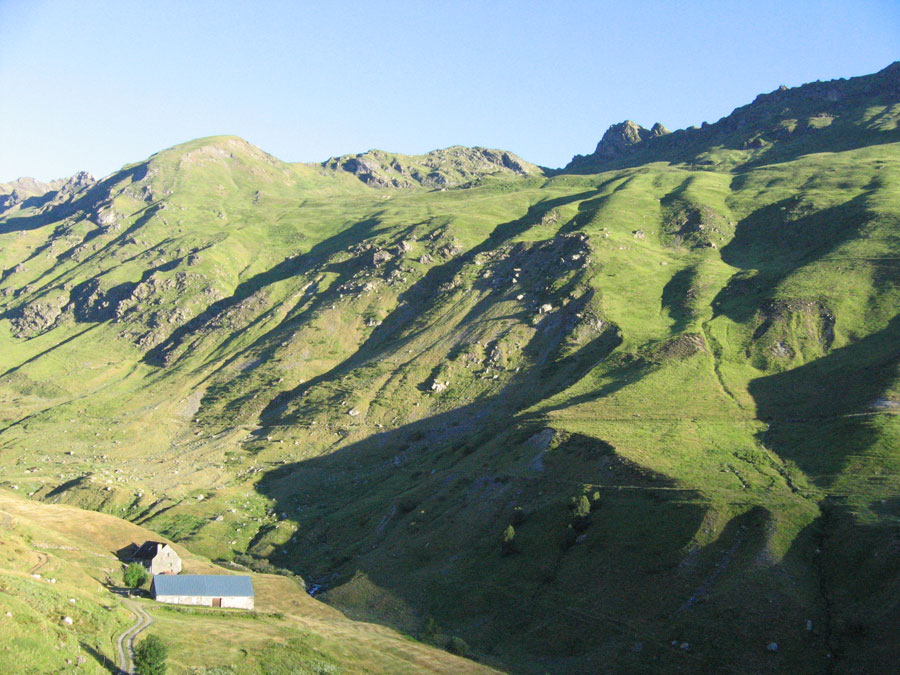
Between Gavarnie and Luz-St-Sauveur on the GR10
I estimate that from mid-June to mid-September, about 10 people leave Hendaye every day, with the intention of walking a significant part of the GR 10, though most of them will take several years to do it. Only one or two people leave Banyuls in the other direction. Some days I saw almost nobody; other days, particularly around popular centres I met 10-20 other walkers. Many parts of the GR 10 are also suitable for shorter walks.
Walking the GR10 with a dog. What are the rules?
Having been asked several times if walkers can bring their dog with them trekking, I have now compiled a list of the restrictions on dogs in the Pyrenees.
Is it safe to walk alone?
As long as you are good at map reading and stay on the path, whatever happens, somebody will turn up. Sooner or later. Being in a group won’t stop you breaking your leg, or save you from being attacked by a bear.
Are the bears dangerous then?

Marmottes (groundhogs) were reintroduced to the Pyrenees in the 1948; bears have always been there
Statistically speaking, no. You are more likely to be killed in a plane crash in the Pyrenees than by a bear. Nobody has been killed by a bear since the invention of the airplane, but the wreckage on the GR 10 on the slopes of Canigou is testimony to the unreliability of aircraft.
In fact, there are only 64 bears in the Pyrenees (2020), so you are unlikely even to see one – which is why I have a picture of a marmotte here. You definately will see marmottes.
If you do see a bear it will probably ignore you. If you are still uneasy, extensive advice on bears is available on backpacker.com. Questions in the forum include such interesting topics as “Will backcountry sex attract a bear?”, “Do Tasers stop bears?” and, for the really paranoid, “Will my farts attract a bear?”.
Whatever you do, don’t wear a sheepskin coat. Several hundred sheep are killed by the bears each year (out of a population approaching half a million).
What are the other dangers?

Heat. Thirst. The Pyrenees are a long way south and, although mountains get colder as they get higher, walkers get hotter as they climb them. The air gets thinner as well so there is less protection from the sun’s rays. In some areas there are surprisingly few springs. Dehydrated water (water purifying tablets) is useful.
Cold. Wet. There are glaciers not far away but they don’t cool the atmosphere much. The main worry is thunderstorms. The temperature can drop 15 degrees Celsius in as many minutes. Thunderstorms can occur at any time, but it always seems to me that they roll in round about 16h00.
Gravity. Not so much the danger of falling off a cliff, but the danger of carrying too much and wearing yourself out to the point where you become too weak – and fall off a cliff. See the equipment list below.
Dogs which think they are sheep. Pyrenean patous are big white dogs which have been brought up with sheep to the extent that they identify with them. They think they are sheep. They see their job as attacking anything else, other dogs and walkers in particular. Avoid coming between them and their flock. Under no circumstances try to force your way through the flock. Even if the alternative is scrambling or turning back, do not make the patou angry. You will be bitten and it will be your fault.
Trailheads (access points) from France
Public transport will get you to the following trailheads on or near the GR10
• Hendaye
• St-Jean-Pied-de-Port
• Etsaut
• Cauterets
• Luz-St-Sauveur
• St Lary
• Mérens-les-Vals
• Bolquère
• Villefranche-de-Conflent
• Banyuls
In addition, many hostels and huts on the GR 10 are accessible by car
Supply points on the GR10
- Ainhoa
- St-Etienne-de-Baïgorry
- St-Jean-Pied-de-Port
- Bagargrak (Iraty)
- Lescun
- Gourette
- Arrens-Marsous ?
- Cauterets
- Gavarnie
- Luz-St-Sauveur
- Barèges
- St-Lary
- Luchon
- Aulus
- Seix
- St-Lizier
- Auzat (2km)
- Bolquère
- Arles
- Le Perthus
And, if you let them know in advance many hostels and hotels will make you a picnic. Bon appétit !
Cash
Many refuges will only take cash or cheques drawn on a French bank account. I once spent 100 euros on a taxi because I had run out! There are cash machines (ATMs) on the GR10 in Hendaye, Sare, Saint Étienne de Baïgorry, St Jean Pied de Port, Arrens-Marsous, Cauterets, Luz Saint Sauveur, Bareges, Saint Lary Soulan, Bagnères de Luchon, Seix (off route), Bolquère, Arles sur Tech, La Jonquera and Banyuls. Source Visa ATM locator (Feb 2018)
Navigation

Banana trees in front of classic Basque etxe (houses) in the foothills of the Pyrenees
The French IGN publishes maps of the whole of the Pyrenees at 1:25,000 which are useful for short sections, but the GR 10 is 400km long as the griffon vulture flies (and 850km long as the rambler walks), so it would take a map 16m long to cover the whole walk. In any case sketch maps are included in the Paul Lucia’s guide, and detailed 1:50,000 maps in the FFRP version.
However, the best, though not the cheapest solution is a GPS with onboard maps. I have a GPS eTrex Summit HC (229 euros). Although you can just buy the two GPS maps needed for the Pyrenees (258 euros), you might as well buy the whole of France as it only costs 21 euros more.
Whether you buy the maps or not, you can always view and download the tracks from Wikiloc.
See also my discussion of free downloadable maps of the Pyrenees.
GR10 GPS tracks (format GPX)
GPS files shared by GR Infos
Hendaye to Estérençuby
Distance: 111 kilometres
Elevation min: 2 metres, max: 1023 metres
Accum. height uphill: 5575 metres, downhill: 5340 metres
Estérençuby to Borce
Distance: 104 kilometres
Elevation min: 244 metres, max: 1920 metres
Accum. height uphill: 6664 metres, downhill: 6316 metres
Borce to Cauterets
Distance: 79 kilometres
Elevation min: 588 metres, max: 2450 metres
Accum. height uphill: 6232 metres, downhill: 5958 metres
Cauterets to Lac de l’Oule (via Gavarnie)
Distance: 92 kilometres
Elevation min: 709 metres, max: 2732 metres
Accum. height uphill: 6164 metres, downhill: 5272 metres
Lac de l’Oule to Etang d’Araing
Distance: 106 kilometres
Elevation min: 534 metres, max: 2264 metres
Accum. height uphill: 7851 metres, downhill:7692 metres
Etang d’Araing to Etang de Guzet
Distance: 102 kilometres
Elevation min: 535 metres, max: 2231 metres
Accum. height uphill: 8161 metres, downhill: 8531 metres
Etang de Guzet to Mérens les Vals
Distance: 104 kilometres
Elevation min: 731 metres, max: 2393 metres
Accum. height uphill: 7545 metres, downhill: 8027 metres
Mérens les Vals to Batère
Distance: 111 kilometres
Elevation min: 922 metres, max: 2477 metres
Accum. height uphill: 7260 metres, downhill: 6840 metres
Batère to Banyuls
Distance: 85 kilometres
Elevation min: 3 metres, max: 1472 metres
Accum. height uphill: 4525 metres, downhill: 5990 metres
Theoretical totals: 894km, 59,970 metres uphill.
Hostels and huts on the GR 10

Goats at Rouze, in the Ariège
You can always carry your home on your back – and save money – but have you seen how fast snails move? A tent (and all that goes with it) is not essential equipment for the GR 10 and adds greatly to weight. With good planning you can always have a roof over your head, though some of them may be a little precarious.
When I walked the GR 10, I tried to arrange my overnight stops at intervals of 6-8 hours walking apart – any longer turns enjoyment into endurance.
Think hours. Forget distances, they are meaningless in the mountains. Count 300m climbing or 500m descent per hour and even then you will be doing well.
The FFRP guide gives reasonable timings for a fit walker who is used to carrying a full rucksack.
Huts and shelters (cayolars, cabanes, orrys)

Lac d’Estaing
According to Pyrénées – cabanes et refuges, a wonderfully useful site, there are 775 huts and shelters in the Pyrenees, many of them on or near to the GR 10. The site gives details (in French). The huts are free, but some are locked or occupied by a shepherd, others semi-derelict. Nothing can be taken for granted, even the existence of a roof, so arrive early. I do know of a few which are as comfortable as some refuges gardés, but they are exceptional.
Hostels (refuges gardés)
Pyrénées – cabanes et refuges lists 63 though some that I have stayed in are missing. Evening meal, bed in a (mixed) dormitory, breakfast, and a picnic lunch will come to about 42 euros. This may seem expensive for basic accommodation, but the costs of running a refuge are high, given the transport difficulties. Blankets are always provided but a sheet sleeping bag is essential. Most provide sandals. Booking one or two days in advance is fine, though if you are really stuck they will find you a space on the floor. Many have no mains electricity so hot water may not be available (or may be possible for a small fee). You will need to carry cash for payment.
See also le Guide gites d’étape et refuges.
Bed and breakfast (gîtes d’étape)
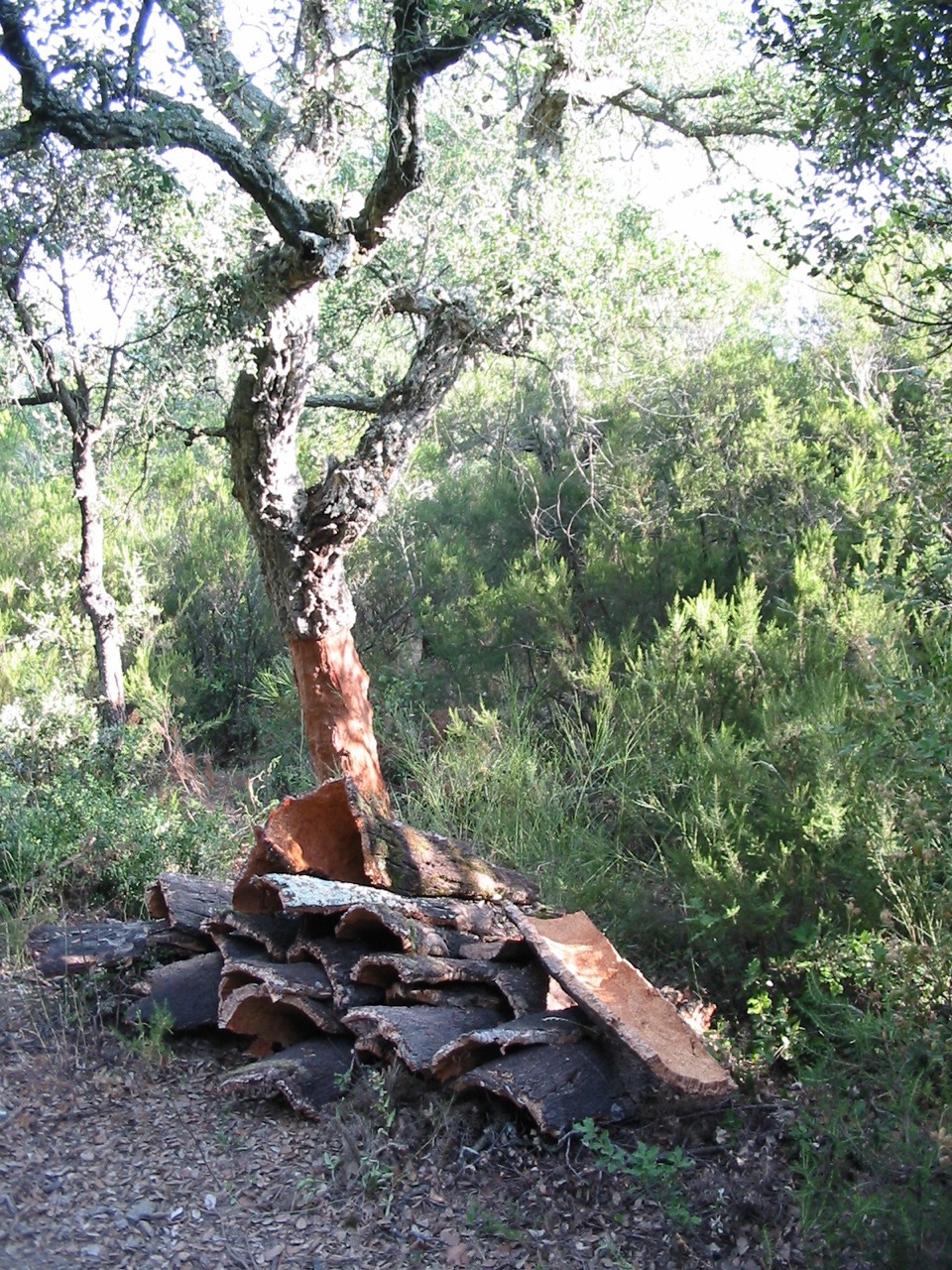
Cork oak near the Mediterranean end of the GR 10
A step up from a refuge gardé, a gîte d’étape will cost 5 to 15 euros more. You will still need a sheet sleeping bag but are more likely to find rooms with 2-4 beds available. Booking is essential. Pay in cash, or French euro cheques.
Hotels
There are hotels, and sometimes no cheaper alternatives, in the few (small) towns along the route.
Sections of the GR 10 without organised accommodation
There are a few sections where trekkers need to sleep in a hut, or walk a very long way in one day. These are the only sections where a sleeping bag is necessary.
The main problem is in the Ariège. The official slogan for the département used to be “Terre courage” and I interpret this to apply to the GR 10.
The walking times given below are taken from the FFRP guide.
Gabas to Gourette (8h50)
There are huts at Cézy clearly visible from the GR 10. At a push it should be possible to do the whole leg in one day, thus obliviating the need for a sleeping bag until you reach Eylie d’en Haut in the Ariège (about Day 33 on a 60-day schedule).
Bagnères de Luchon to Fos (about 10h00)
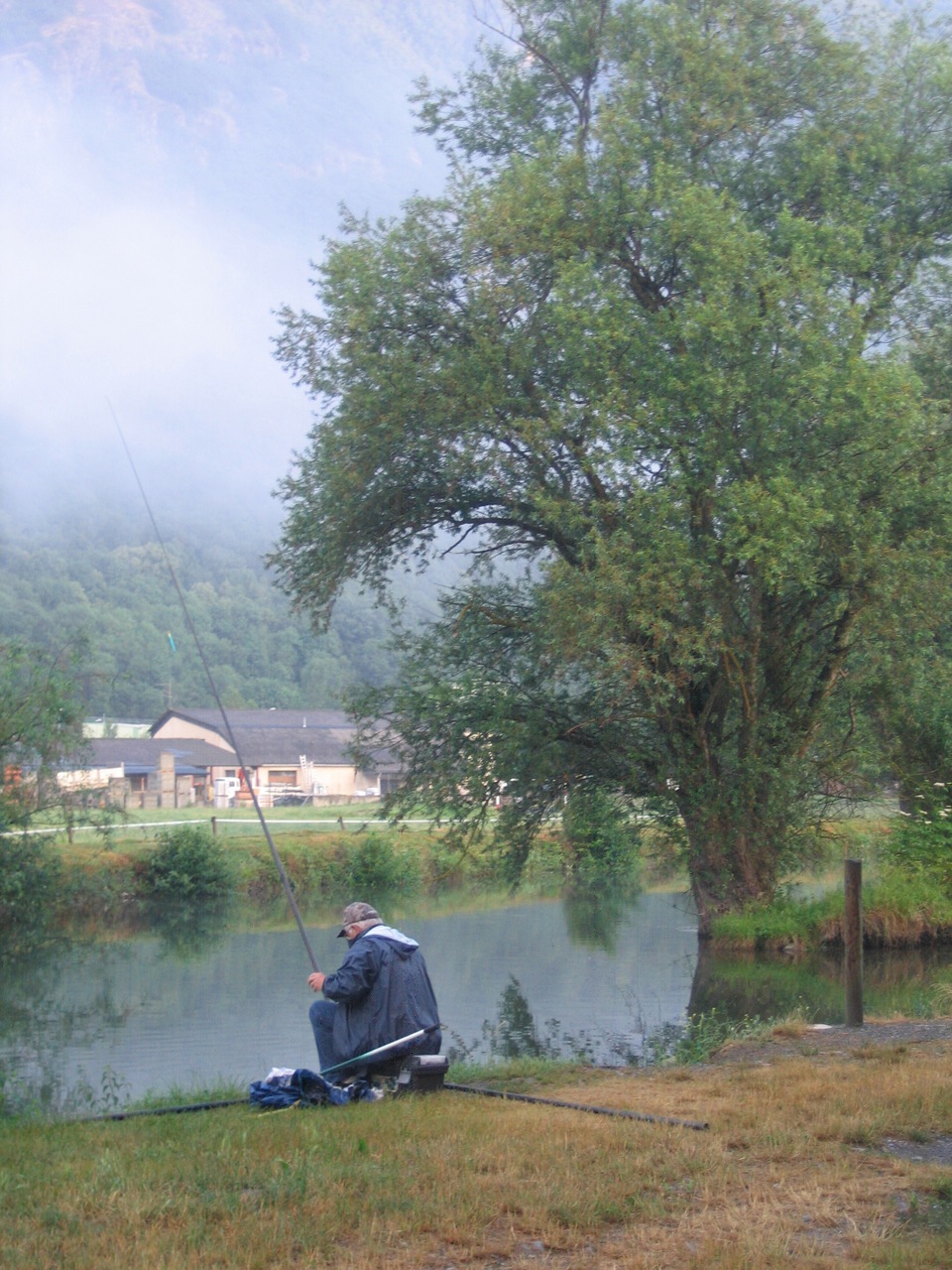
Fisherman on the river just north of Luchon
There is a new gîte d’étape at Artigue which means that this section can now be split over two days.
Apart from that there are two huts at the Cabanes de Peyrehitte (one is reserved for the shepherd). There is a water trough a little further along the GR 10.
Eylie d’en Haut to Esbints (3 days, 2 nights – 19h40)
This used to be a particularly difficult section from the point of view of accommodation, with two consecutive nights in huts, but there is a new gîte at the Pla de la Lau. Unfortunately the stage is still a little too far to be done in two days, one after the other.
- Day 1: Eylie to Gîte Auberge Maison du Valier (Pla de la Lau) 9h35
- Day 2: Gîte Auberge Maison du Valier (Pla de la Lau) to Esbints 10h05 (no thank you!)

Lac d’Aubert in the Néouvielle National Park
So the followings huts (listed west-east) may be useful
- The Cabane de l’Arech
- Cabane de Besset
- Cabane du Trapech du Milieu
- Cabane du Pla de la Lau has now become the Gîte Auberge Maison du Valier. Great news!
- Cabane d’Aouen. This is in two parts, one of which is reserved for the shepherd in summer, so there are only two places.
- Esbints. Not only the gîte at the end of the struggles, but also a great place to stay.
- After Esbints there is another new gîte d’étape in St Lizier d’Ustou.
Goulier to Rulhe (4 days, 3 nights)
The most difficult section of the GR 10 accommodation-wise.
- Day 1: Goulier to Siguer 4h05
- Day 2: Siguer to Cabane du Courtal Marti 5h30
- Day 3: Cabane du Courtal Marti to Cabane d’Artaran 5h40
- Day 4: Caban d’Artaran to Refuge du Rulhe 5h45
- Siguer. Ask at the mairie (town hall) for the keys to the room near the salle des fêtes.
- Cabane du Besset d’en Haut at Col de Sasc – there is a concrete hut a little way down the slope but there is no door or window. To be avoided.
- Cabane du Courtal Marti. A much better alternative to the Cabane du Besset d’en Haut is this former shepherd’s hut only an hour further on.
- Cabane de Balledreyt. 632m beyond the Cabane du Courtal Marti.
- Cabane de Clarens. In bad condition but there is still a roof.
- Cabane d’Artaran.
- The ski resort on thePlateau de Beille is 30mins walking from the Cabane d’Artaran. Angaka can provide tents and food if booked in advance. For more information ring 05 61 01 75 60. I haven’t tried this, but they are well organised: I have been dog sledding with them.
There is also a restaurant at the ski resort, open at lunchtime.
This is the last possibility before the refuge de Rulhe, as the Cabane de Beille d’en Haut is private, though I was told by a waiter at the ski resort that part of it was available for walkers. Further along, the Cabane de Poussiergues may be useable but don’t bet on it.

Basco-bearnaise sheep, just arrived for their summer holidays
Mérens
This gîte is closed for 2010. It is possible to sleep in the Chambres d’hôtes du Nabre or on the municipal campsite. The campsite has several tents with duvets available for walkers. Ring 05 61 02 85 40
Equipment
As a result of walking the GR10, having lugged anything from 12-18kg on my back, I revised my ideas of “necessary” items. On a recent 4-day walk round – and up to the top of – the Posets (the second highest summit in the Pyrenees, 3375m), I carried the following (plus crampons and piolet, not necessary for the GR10). I don’t see any reason to carry any more on a longer walk.
My GR 10 kit list
| GR 10 FASHION |
g | notes |
| boots | 1824 | with high sides which are great for my ankles |
| anorak | 775 | Gortex |
| trousers | 304 | lightweight trousers with detachable legs (Columbia) |
| tee-shirt | 160 | synthetic so that it dries quickly – not cotton |
| belt | 97 | |
| underwear | 80 | |
| socks | 74 | |
| TOTAL | 3314 | |
| ACCESSORIES | ||
| water | 1548 | 1.5 litres |
| rucksack | 330 | from zpacks.com. The version I have is no loger available but you can get an Arc Blast (465g) |
| winter fleece | 731 | |
| 4 GR10 guides | 640 | contain maps at 1:50000 |
| food for the day | 500 | |
| camera | 273 | |
| first aid kit | 246 | |
| 2 tee-shirts | 238 | |
| shorts | 217 | top half of lightweight trousers |
| pole | 202 | |
| battery charger | 194 | |
| waterproof leggings | 177 | |
| GPS | 173 | with integrated maps |
| sun cream | 149 | |
| wallet | 142 | |
| Mars bars | 130 | |
| spare batteries | 111 | |
| phone | 108 | |
| sheet sleeping bag | 101 | silk |
| travel towel | 97 | microfibre (Boots) |
| Swiss army knife | 86 | |
| shampoo | 80 | |
| toilet paper | 78 | |
| hat | 78 | |
| head torch with batteries | 78 | |
| 1 pair socks | 70 | |
| emergency blanket | 61 | |
| glasses | 54 | |
| toothpaste | 31 | |
| soap | 30 | |
| earplugs | 30 | |
| plastic bags | 25 | |
| plastic cup | 23 | |
| Compeed | 18 | |
| toothbrush | 17 | |
| water purifying tablets | 13 | |
| cigarette lighter | 12 | for lighting fires in emergency |
| pen | 9 | |
| whistle | 9 | |
| TOTAL | 7109 |
Things I don’t think necessary include:
- sandals (provided at most refuges – otherwise walk around in socks)
- deodorant – positively dangerous it as it stops you sweating naturally
- a razor, even if you have better-looking legs than I do.
Other kit lists
- http://www.pyreneeshike.com/kitlist.html (34.2lb, 15.5kg)
- Mountain bug (no weights given)
- Mountain is good (21kg plus water)
My best bits
Hourquette d’Ossoue, the Vignemale, and Gavarnie

The Cirque de Gavarnie is one of the best-known images of the GR10
To my mind the best section of the GR 10 is the detour which goes from Cauterets to Luz-St-Sauveur via the Hourquette d’Ossoue (2734m) instead of directly to Cauterets. Most people miss it out, which is a shame. It starts with a 3km-long waterfall up to the Pont d’Espagne. Then there is the Lac de Gaube, one of the defining sights of the Pyrenees (get there before 9am and have it all to yourself). Followed by the long, long Gaube valley, with the dark north face of the Vignemale at the end, and the pass at the Hourquette d’Ossoue. A short diversion takes you to the top of the Petit Vignemale (3032m) which overlooks one of the larger glaciers in the Pyrenees.
An overnight stop in the Bayssellence refuge will give you time next day to saunter down to Gavarnie, sign into the hostel, and visit the Cirque. Victor Hugo variously called it nature’s coliseum, a hippodrome, a Parthenon, a cathedral, a Kremlin, boas rolled one above the other, the mouth of a volcano, a storm trap and, beginning to let his imagination run away just a little, a Tower of Babel turned over and imprinted in the earth like a seal.
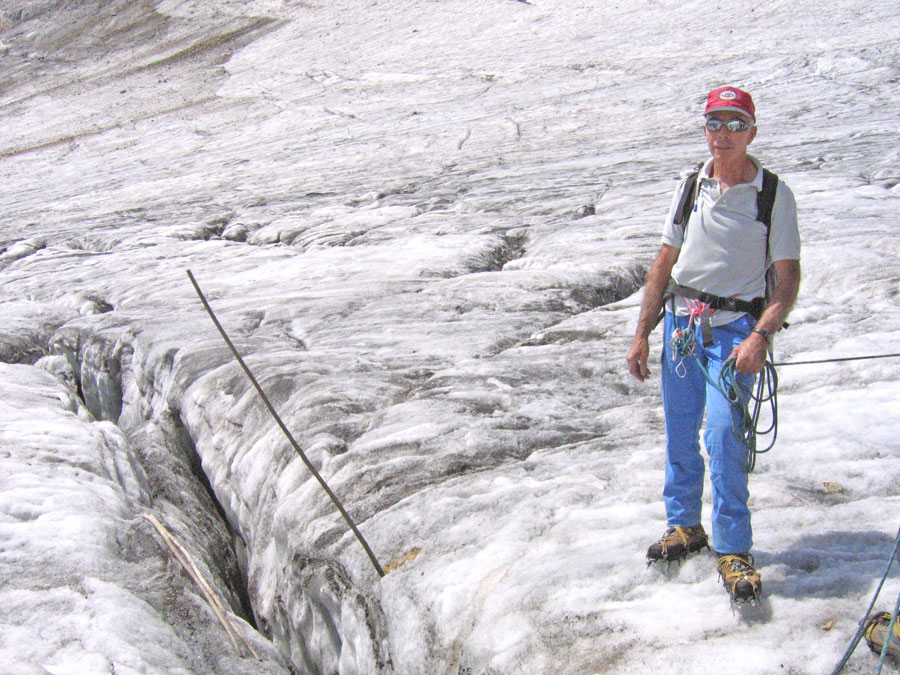
Our guide on the Vignemale glacier
Better still leave leave the visit to the Cirque until dawn the next day and only walk as far as Gèdre that day. After that you have a rollicking roller-coaster path down to Luz-St-Sauveur to rejoin the main route.
Grand Vignemale
If you take the above variant, there is the opportunity to climb the Vignemale (3298m), crossing the Glacier d’Ossoue. You will need crampons and a guide, but both can be arranged at the Bureau des Guides in Cauterets.
Canigou

On a clear day the Mediterranean can be seen from the top of Canigou
You can walk round the Catalans’ favourite mountain, but the official GR10 between the refuge de Mariailles and the Chalet des Cortalets, is a long detour. Much more interesting – and quicker – is the variant which goes to the top of the mountain (at least on a fine day). There is a bit of hands-on stuff just below the summit – but don’t let the name “La cheminée” – the chimney – put you off. It is perfectly possible with a rucksack. And once you have hauled yourself up to the cross, there is an incredible view of the Mediterranean.




Hi Becky
I’m glad you find the site useful. Yes 4 nights in cabanes followed by a night in more comfortable accommodation sounds fine. But think in terms of refuges as they are cheaper than gîtes d’étapes (and there are not that many gîtes d’étapes on the GR10 anyway). The main factor is how much food you can carry without it slowing you down – try doing a four-day hike in MOUNTAINS with all you are intending to carry to see how it shakes down.
I don’t know how much long-distance walking you have done but the main physical problem is the creeping tiredness from walking day-in day-out. I’ve met so many people who have given up because they pushed themselves too much, or they were trying to keep to a schedule. One bloke persuaded himself that he could do the whole thing in 60 days with no stops. After 30 he was half way there but so tired and miserable that all he wanted to do was to go home. If he’d taken 2 days off at that point I’m convinced that he would have made it. But the physical tiredness had left him so depressed that he wouldn’t even consider it. So what I am suggesting is that you should take each day as it comes. Certainly plan everything in detail, but above all don’t expect to keep to a schedule. Most walkers can’t do more than seven hours a day over a long period. Your friends will have to be flexible!
Above all enjoy!
Steve
Hi Max
Sorry to be so long in replying but I’ve been in Seville. The third week in May is early for the GR10, and although SJPP is still low, by the time you get to La-Pierre-St-Martin you are in ski country. You will probably get through but look at the webcam. Getting back to Bayonne from Etsaut is easy. The bus connects with the train which now goes as far as Bedous.
I hope this helps
Steve
Hi,
Im thinking of doing the portion of the GR10 that is from Cauterets to Luz-st-Sauveur in March and I’m wondering if that is too early for the trail? Also if you have any advice regarding the accommodation/itinerary it would be grand!
Hi Steve
Moving on with our planning and training for our trek later this year. I have found a great GPS app that i have tested locally which works very well – Alpine Quest. It has the GR10 and other trails around it marked very clearly. Do i need paper maps too? They look like a unnecessary expense and weight but should i have them for a backup?
thanks
chris
Hi Chris
Since there are two of you and you can have the app on both phones, the only real worry is that the phones doesn’t pick up the GPS signal for some reason. Normally there will be waymarks anyway. That said, I always carry a photocopied map so I can get a better feel for the area if I need to plan an alternative route, which is difficult to do on a phone. As for expense, you can download free maps and print them out: see my site on the GR11 http://www.lasenda.net/free-maps-of-the-pyrenees/
Happy planning
Steve
Hi Steve,
I highly appreciate your work and experience you’ve put in here. Very impressive I must say.
I do have one question though: I read somewhere that there is a suspension bridge on the gr10. It noted though that crossing it is only an alternative. As I am scared of heights and can’t cross bridges like that, do you know if there’s a way around it or even better that it is just a chooseable alternative?
Thanks and kind regards,
George
Hi George
I suspect you are thinking of the Passerelle de Holzarte, south of Logibar. The main GR10 no longer goes that way but climbs up a ridge to the E. So no problem.
Have fun
Steve
Hi Steve
Flying to Biarritz 21/6/18 then on to Hendaye same day.
Are you able to advise a suitable camp site in Hendaye for two x one man tents? Start GR 10 next day – 12 stages.
Also, do you know if Coleman type screw on gas canisters are available in Hendaye.
Thanx MB
Thank you for your reply Steve, much appreciated. Ridges don’t bother me much its just the suspension bridges that are just not doable for me. So it looks like I’ll be able to do it, yaay. What about the GR11, any suspension bridges there?
Cheers,
George
I can only remember one suspension bridge near St Aniol d’Aguja and it is short. There may be others but evidently they are not etched in my memory!
Hello Martin
There are loads of campsites in Hendaye, though they tend to be aimed at people with cars. The nearest to the station is the Camping Ametza but I can’t recommend any one in particular.
As for Coleman type screws, see this site for details on camping gas cylinders and connections in France.
I hope this helps.
Steve
Hi Steve, My wife and I finished the GR10 last year (over 5 years in stages) and had the most amazing time. We have a week off after easter and wanted to go back to the lower pyrenees and do some walking if it is possible at that time of the year? Any suggestions for first week of april? Great website btw, regards, Shane
Hi Shane
Good to hear that you enjoyed the GR10. There’s a lot of snow at present, more than usual, but in any case you can expect snow from 2000m in the first week of April. For example Canigou will be inaccessible without crampons. That still leaves a lot of choice…
Have fun.
Steve
Hi Steve, I am planning a trip to the Pyrenees at the end of August. I am planning to base myself in gavarnie. Would there be enough day hikes for five days.
Hi Steve
Just bought your first Pyrenees book via Amazon.
Not many blogs stay active for this long impressive stamina & useful too, thanks.
What’s the latest through route date for the GR11, I’m thinking of a late start from the Med. side.
Hi Rusty
I hope you enjoy the book. For the latest through-route dates see my article “Snow reports for walkers in the Pyrenees“.
Have fun
Steve
Hi Steve, Huge thanks for providing this resource to hikers! I am planning on doing the GR10 W-E this summer, and have two questions for you:
1) I need to fly home by August, so I’m planning to reach Gabas on June 24 and cross the Hourquette d’Arre on June 25. It looks like the snow is heavy this year, so I probably can’t rely on the June 14 snow-free date — I know it’s impossible to say with certainty, but do you have any guesses what conditions will be like on June 25? A bit of snow doesn’t bother me, but if there’s a good chance it’ll be deep enough to require crampons/present an avalanche risk, I’ll look into alternatives.
2) If I need to detour around Hourquette d’Arre on June 25, can I assume that I would also need to detour around Hourquette d’Ossoue on June 29? I’d hate to miss that stage, so if this is the case I might just plan to start the GR10 ten days later, end at Merens les Vals, and return another year…
Many thanks for the advice!
Hi Sarah
1) You say you need to fly home by August. When in August? Yes you are right about the heavy snow but 25 June could still be OK. In any case you can avoid the Hourquette d’Arre by heading north from the Cabanes de Cézy to just short of Eaux-Bonnes where you can turn east for Gourette.
2) You are also right in thinking that the Hourquette d’Ossoue is one of the best sections of the GR10 and it would be a pity to miss it. But coming back another year would take something away from the walk. It seems to me that there are two options if there is still snow. a) hire an ice axe and crampons in Cauterets (ask about conditions in the Bureau des Guides in any case) or b) miss out the Hourquette d’Ossoue but come back by train from Banyuls to Cauterets and walk it then.
How many days have you allowed for the whole walk? How much experience do you have of long-distance walking, by the way?
I hope this helps.
Thanks for the reply! My flight back is on July 29th; I’ve budgeted 48 days total, including 3 rest days. I’m 30 and have done several six day backpacking trips in California and Patagonia averaging 20-22 km per day, but I’ve never done a longer trek — I’m hoping the ability to pack lighter on the GR10 can compensate for my lack of thru-hike experience, but will see how it goes! I like the suggestion of returning to Hourquette d’Ossoue later on/in another trip to the Pyrenees rather than delaying and truncating the entire hike — I think I’ll book gites/refuges in accordance with my 48-day plan and take the La Sourde and Col de Riou detours if snow gets in the way.
Hi Rusty
I’m not sure what you mean by “if I decided to return after a few days by the Med. on the GR11.” Can you explain more, thanks
Hi Sarah
Can you let us know if you do encounter snow, please? It will be useful for other early birds.
Don’t bother booking everything in advance. It is only necessary for 14 July weekend. Normally you can ring two days in advance (or get refuge to ring for you where you don’t have any coverage). If you book everything you risk not being able to take that rest when you really need it.
Good luck
Steve
Hi Steve, After many years, I’m making the opportunity to walk G10.
An there AYM’s anywhere nearby or do I need to take cash with me?
Hi Frank
Excellent question. I once spent 100 euros on a taxi fetching cash because I had run out! There are cash machines (ATMs) on the GR10 in Hendaye, Sare, Saint Étienne de Baïgorry, St Jean Pied de Port, Arrens-Marsous, Cauterets, Luz Saint Sauveur, Bareges, Saint Lary Soulan, Bagnères de Luchon, Seix (off route), Bolquère, Arles sur Tech, La Jonquera and Banyuls. Source Visa ATM locator (Feb 2018)
Hi Steve, Thanks for you quick reply re ATM’s.
Next it has been suggested to me that I take a GPS with me. Which of the many do you suggest? Is it solar-powered? Does it use a sim card that needs reloading?
Again thanks
Hi Frank
Yes, take a GPS (or a phone with Wikiloc app loaded), see my page on how to use a GPS. You need one that you can put maps onto: Free maps of the Pyrenees. Any recent Garmin will do, though there are may other possibilities. No they are not solar powered, you need spare batteries and a charger. Yes you will need a sim card with sufficient memory for the map you choose.
best wishes
Sarah / Steve
Eastward from the Atlantic is what I mean.
I won’t hold your youth against you.
Back on the GR 11 if I feel like it.
In my 50’s but stronger than I was in my 20’s, done a few long distance routes including the South West Coast Path (in two trips).
Tend to be a little ambitious & end up injured so I will be taking it very easy to begin with & taking plenty of rest days.
Travelling with a tent & a stove so costs will be low also lower “other people are hell” risks 😉
Thanks Steve, your a great (impartial) help.
Hi Steve – great website & really helpful. I am thinking of doing a 5 week stint mainly on the GR10 but thinking of crossing to GR10 & getting as far as Espot. The crossing via Portillon de Benasque at Bangneres de Luchon in terms of distance & time is not clear – what the options – presume Hospice de Luchon is the best starting place?
Steve
Hi Steve, I plan do walk G10 this summer, on my own, what is a good light-weight tent?
Thanks Frank
Hi Steve
I presume you mean crossing over to the GR11. You can hitch/bus/taxi from Bagnères de Luchon to the Hospice de France and then climb to the Refuge de Venasque and down to the Hospital de Benasque and take a bus from there to Benasque. The walking part is spectacular, particularly when you arrive at the Portillon. It is 10km and 1000m of climbing which should take you 6h00. However an alternative option would be to cross over to the GR11 from Gavarnie to Bujaruelo which 13km and 1000m climbing so would take 6h30. The advantage of this option is that there are no roads involved.
Have fun.
Hi Frank
Sorry but I can’t help on this. Your best bet is to look at Andy Howell’s page which details all you need to know on lightweight tents.
Best wishes
Steve
Jemma Chapman sent me the following message for you, Steve.
I did this last year. The walk from hospice de France to hospital de Benasque is beautiful. I got a shuttle from the office du tourisme in luchon to the hospice, it left at 09:30. The bus from the hospital de benasque to the town runs 3 times a day (at 11:00,14:00 and 17:00 last August)but I hitched into town from the hospital car park easily. Hope you have a good trip.
Thanks Steve & Jemma for the response re Benasque- looks like it will be a highlight of my trip!
Hi Steve,
We’re looking to do Cauterets to Luz-St-Sauveur the last weekend of May. Is this going to be possible or still too snowy?
Clare
Hi Clare
If you are thinking of walking the direct path (and not going up to the Oulettes de Gaube) it might be possible but today there is 115cm of snow at the bottom of the slopes (1700m) and 290cm at the top (2300m), which is exceptional. Keep an eye on the Luz-Ardidan ski resort webcams. The col de Riou is at 1940m and the approach is 30°. 1940m is not very high but if there is still a significant amount of snow it could be unstable. It is one of these things you can’t predict as yet, but I would work on the assumption that it will be OK – you can always get a bus to Lux via Pierrefitte.
Keep safe, Steve
Hi Steve
Can you delete my post with my email included, I was stupid to post it.
BTW
Solar is getting cheaper by the minute just bought this off Amazon for £30, it charges at the advertised rate, 2-3 hours for a smart phone even on a cloudy day in the UK.
https://www.amazon.co.uk/gp/product/B01CHFVBX0
Thanks.
Thanks Steve, much appreciated!
Hi Steve,
Congrats on a fantastic trove of knowledge!
I’d like to plan a 10-14 day route for my family including wife (experienced Nepal hiker) and two sons (11 & 13, fit day-hikers).
Our dates are any time in July (I have left the month open).
I have been trying to decide between GR10, GR11 and even HRP, and also between staying in huts or lugging a tent (I know you are all about ultralight).
Ideally we want to avoid giant boulder fields and anything technical, but we do love dramatic views.
Please let me know what you would recommend.
Thanks!
Hi Jordan
I like wild and dramatic but not too mineral, so my ‘best bits’ reflect this.
GR10
The GR10 is the best organised of the three routes in terms of accommodation. And so many people have now walked it that the path is well defined. For me the best bit is the Cauterets – Bayssellance – Gavarnie loup.
GR11 most difficult stages
• Góriz to Pineta
• Baiau to Arans if you go on main route but much easier if you head east from Baiau initially
• L’illa to Malniu. Beware of late snow at the Portella d’Engorgs. You can go around to south but this involves a boulder-hopping descent.
GR11 most beautiful stages
• Zuriza to Aguas Tuertas to Cancanchú*
• Salent de Gállego to Bujaruelo
• Torla to Pineta
• Puente de Coronas to Espot*
• Nuria to Ulldeter**
HRP most difficult stages
• Egurguy – Iraty very steep near start
• Iraty to Ardane Gagnekoa spectacular narrow ridge, Zazpigain but OK if you don’t have vertigo
• Somport to Pombie annoying boulder field just before the Col de Peyreget
• Pombie to Arremoulit, exciting corniche Passage d’Orteig
• Arremoulit to Respomuso steep descent on scree
• Biados to Soula, steep climb on screen and boulders after Anescruzes, didn’t like that at all.
• Soula to Portillon to Rencluse to Conangles a tricky section probably best avoided
• Saboredo to Fournet annoying boulder fields
• Certascan to Soulcem, worst boulder field I know after Port de l’Artiga but most beautiful lakes in the Pyrenees, Estanys de Romedo!
• Soulcem to Fourcat to El Serrat, more boulder fields
HRP most beautiful stages
• Gavarnie to Héas to Bielsa
• Conangles to Saboredo
• Fornet to Soulcem**
• Juclar to Hospitalet to Bouillouses
• Eyne to Ulldeter*** to Pla Guillem (except for the ski resort at Ulldeter!)
See also my site on the GR11, Senda Pirenaica, this page on cross-border routes, and this page comparing the GR10, GR11 and HRP. There are also reports on the Senda de Camille, the Mountains of Freedom, and a cross-border walk taking in Aneto.
Hi Steve,
I posted a while back asking for your thoughts on accommodation/distances when I was planning on walking the whole GR10 route this summer. My plan has since changed and I won’t be able to go for a way as long as I’d hoped for (combination of not being able to take 2 months off work and also buying a house so needing a salary!)
I still intend on going mid-August to early Sept, for 2.5 weeks and hiking as much of the midi-Pyrenees as I can in that time (perhaps roughing it a bit more accommodation wise given that I am only walking for a few weeks).
What I wanted to ask was, if I’m coming from the UK and can do around 17 days away in total, where would you suggest I start and end (i.e. a combination of the best access but also the best views!)
Any thoughts greatly welcome 🙂
Many thanks!
Rebecca
Hi Becky
Two possibilities with easy train/bus access: Etsaut to Luchon or Luchon to Mérens. The former has some of the classic sights of the GR10 – Lac de Gaube, Vignemale, Gavarnie, Néouvielle, Lac d’Oo – but will busy in August. The latter has less organised accommodation but free huts you can stay in if you don’t mind slumming it. Around the 15 Aug you will need to book in advance because it is a Bank Holiday.
Have fun
Hello
Great site.
I want to walk this walk. Atlantic to Med. I also want to follow as high a route as possible.
Are there GPS Routes for the “high” route?
Is accommodation good or not good when staying up high?
Is there a day by day route available for the high route?
Thanks
Jim
Hi Jim
There are three main routes in the Pyrenees going from the Atlantic to the Med. The GR10 on the northern side, the Pyrenean Haute Route (HRP) which is the highest and crosses the watershed on the French/Spanish border many times (I counted 28!), and the GR11 La Senda Pirenaica on the south side. I have written an article on another site comparing the three Pyrenees routes. It sounds like you would be looking towards the HRP (known in French as the Haute Randonnée Pyrénéenne).
Yes there are loads of GPS tracks for all three routes, see Wikiloc.
As for accommodation, I have done all three routes and can safely say that you do not need a tent. You will be able to find a roof every night. That said, this needs careful planning, see the refuges in the Pyrenees site. Depending on the route you pick perhaps a quarter of the nights will be in free basic huts, a few on a concrete floor but most with at least minimal comfort. 60% of the nights will be in staffed hostels. And 15% in bed and breakfast or small hotels. The hostels and B&B works out at about 55 euros for bed and breakfast, evening meal and a picnic, so doing the whole route like this works out at over 2000 euros. Camping is naturally cheaper.
Yes there are day-by-guide books. The Cicerone Pyrenees guides are great for Anglophones.
[I’m assuming you have already done some long-distance walks and that you are confident for the steep hands-on-rock bits of the HRP. If not I would recommend starting with the GR10.]
Feel free to ask more questions once you have settled on a route.
Happy planning, Steve
New Flora & Fauna Guidebook in English, not on Amazon UK in English but found here:
https://www.nhbs.com/wildlife-of-the-pyrenees-book
Looks interesting.
Hi, I plan to hike section 2 during august. Is there anything I should pay attention to when hiking the gr10 alone as a female? Have there been any incidents as far as you know?
Thanks, Brigitte
Hi Brigitte
I have met quite a few lone women walking in the Pyrenees and none have reported female-specific problems. The only thing you need to look out for in August is the heat, and some refuges may be booked up around the 15 August holiday.
Have fun
Hi Steve, thanks for quick reply. What would you expect would be the average day and night temperature in section two? I actually expected the mountains to be more chilly than fx section 1.
Hi Brigitte. What do you mean by section 2?
Steve – I’ve been reading your site for several years since we first hiked a week from Estaut to Cauterets several years ago – thank you! This year we are newly retired with 6 weeks to ourselves. We arrive Cauterets on July 13 with a tent and stove, and will walk for 6 weeks towards the Med. Yes we’ll have heavier packs, (about 18lb each plus water), but we plan to go very slowly – possibly 2 days for everyone else’s 1 day – and enjoy the scenery with slow picnics and even mid day naps. We’ll be taking full advantage of the Formule Bivouac wherever it is on offer and will report back on how that goes. I do have a question… how does the snow look this year? We last went in a heavy snow year and had a slightly hairy time getting over the Hourquette d’Arre so wondering what the early reports are like.
Hi Alice
It’s good to have the time to do things at your own pace! Although there has been much more than average snow this year, setting out on July 13 you shouldn’t have too many problems. The only place where there might be difficult snow would be in the region of Vignemale but by that date many people will have passed through before you. Ask in the Bureau des Guides and consider the alternative route if necessary. But keep an eye on this page for more snow reports.
Prepare to enjoy yourselves…
Thank you so much – we will indeed keep an eye on your snow report page. I see that 2013 had the most snow ever… that’s when we were last there! Very much appreciate all the helpful info.
To Birgitte; I’m a 55 year old woman, and walk solo all over the world. I’ve walked GR10 solo and am doing it again in August. There’s no problem being a solo female hiker as long as you are sensible (same for any hiker); carry enough water especially in August, and take a mobile phone, battery charger and add the track (get it from Wikiloc and add it to ViewRanger or any other GPS app). And thanks again for your helpful site Steve
Hi, Steve. We have been walking GR10 for several years and your website is the best source of information. Thank you for maintaining the site and sharing your knowledge!
This year in late July we are going to hike from Vielle Aure to Merens Les Vals, but we will take a detour at the beginning stage of the hike to explore Lac du Portillon area. From my previous correspondence with you through this website, you indicated this could be an interesting place to visit. Our plan is to go from Lac d’Oô -> Refuge Espingo -> Refuge Portillon -> Refuge du Maupas near Lac d’Enfer -> Luchon. Since this is not the standard GR10 route, I wonder if there is any challenges we should be aware of. We are fit and experienced hikers, but have no technical climbing skills. If we get there between July 23 – July 28, do we need crampon/microspikes and ice axe? Your input will be greatly appreciated!
Hello Qin Zhu
I considered walking from Portillon to Maupas in 2016 but the more I looked at the less I liked it. It looked more like rock climbing than walking. An alternative would be to go from Portillon to la Renclusa refugio in Spain and then back to the Hospice de France (HRP) and catch a bus down to Luchon. I haven’t done the first day, though the second is magnificent. I suspect you might need crampons to get to the Col de Litérole, though maybe not. There will certainly be snow above Portillon (though not below) at that date.
It is definately worth going up to Portillon whatever.
Have fun, Steve
Hi Steve. Thank you so much for alerting me the difficult nature of the path to Maupas. You are absolutely right! My question is the path from Refuge de Portillon to la Renclusa appears to be HRP Etape 21 (on my GPS map). It seems to be along the ridge to the right of Punta Mamy and Pic des Crabioules. The latter was mentioned by other walkers as being challenging. I wonder if climbing ropes are needed for this portion. We are not trained in rock climbing and would like to be aware of our limitations. Your opinion helps a great deal!
Qin Zhu
Hi
The HRP goes up to the Col de Litérole and then down the other side. It doesn’t go along the ridge. It is steep and if icy you will need crampons and an ice axe, but it is not rock climbing.
Hi Steve,
I am planning a trip to the Pyrenees in August/September. I m travelling with my kum who doesn’t want to carry her bag between stops! I have found a few tour operators who will transfer your bags for you, out favourite itinerary so far is with company called Purely Pyrenees. Do you know anything about them?
Jemma
Hi Jemma
Not carrying bags! A great idea. I don’t know anything about Purely Pyrenees as such. However they are part of La
Balaguère which has an excellent reputation. Go for it.
Steve
Sorry, section 2 I mean from around Orédon. From medio august until beginning of september.
Temperatures depend a great deal on how high you are. Assuming you are in a valley at night, expect min of 10 degrees C, and a max of 25 degrees C in the day higher up in August.
Hi Steve. Do you know the best walking route from La Refuge de Breche de Roland to Camping Valle de Bujaruelo (on the GR11)? I am walking for 3 days in the Pyrenees in July this year and am planning to see the Cirque de Gavarnie on my first day, walking from Gavarnie to Bujaruelo. But the walking route isn’t obvious, once you get to the Breche! I don’t know if I should scramble up to the Breche and down the other side to Bujaruelo, or walk on the north side of the Breche. Can you advise please?
My second day will be spent viewing the Gorge d’Odessa, following the GR11 to Refugio Goriz. For my third day, I’m planning to walk from Goriz back to Gavarnie (probably over the Breche de Roland).
Also, do you think I’ll need crampons in July, or will the snow have cleared by then?
Many thanks for any help you can give.
Hi Laurence
I’ve never walked from the Brèche down to Brujaruelo but you can’t do it on the North side. Even on the south side it must be something of a scramble. The easiest solution would be to go to the Brèche then back down to the Saradets hostel and along at a much lower level to the Puerto de Bujaruelo. After that the route is well used. You can look on Wikiloc to see if there are any other useful tracks.
When you walk the Gorge d’Ordesa consider the alternative to the GR11 of the Faja de las Cazadores on the S side, which is quieter. Going back on the third day, I’ve done Monte Perdido to Saradets, via the Lac Glacé. You could do that or the more direct route. Either way, given the amount of late snow it would be a good idea to take crampons and an ice axe. When I climbed Monte Perdido, we used crampons several times between the Saradets and the Lac Glacé and it was an ordinary year.
An alternative idea would be to go from Gavarnie to Bujaruelo via the Ibon de Bernatuara, something I’ve planned to do for years but never got round to.
Please let us know how it works out.
Sounds great!
Steve
[…] More info: Pyrenean Way […]
Hi Steve
Is there an opinion on how snowy this year will be for a 10th June Atlantic start?
Seems lots of chatter about snow earlier in the year but it seems to have been warmer than usual recently.
Taking some Innov8 Rocklites but not crampons plus iceaxe, they are enough to kick steps in melting summer snow and I have a full set of maps for diversions.
Hi Rusty
There is still snow and no it hasn’t been warmer in the Pyrenees than usual, though there have been some warm days further north. For more information, look at the webcams listed on my page about snow.
Keep safe.
Thanks, I’ll be fine started walking in the mountains 44 years ago, plus I’m a great coward & very robust.
Hi steve,
This year we want to go further on the GR10 from Barreges to Luchon. Do you think this is possible, starting 19th June without crampons and/or ice axes
Hi Frank
It may be possible, but it would be wiser to have them just in case. There has been a lot of late snow and you will be heading straight into the heights. See also my page on snow conditions in the Pyrenees in 2018.
Keep safe.
Dear Steve, reading this blog, I have to say that you are generous with your time and information….thank you.
We haven’t treked for nearly 3 years. Aug 2015, 7 days of the Walkers Haute Route from Chamonix, carrying far too much. 2014 Routeburn + Caples (Tasmania) as a circuit.
Dec. 2012 Torres Del Paine (carrying tent, cooker et al).
Looking for 4-7 days with optional exit points, carry max 14Kg including water, food. want the exhilaration and awe of the mountains….ps I’m scared of vertical drops and thats why we avoided some sections of the Haute Route.
Possibly GR10, GR11, GR20 or ??? and I will then research.
Please reply only if you have time. We can’t travel till maybe Sept or plan for 2019 in the shoulder season.
regards
Simon
Hi Simon
I don’t know the GR20, except by reputation, so I won’t comment on that. I gather you are planning on carrying a tent.
Wild, no drops and exit points tend to be mutually exclusive. On the GR10 for wild and exit points but with some drops (after Oulettes de Gaube) you have Cauterets – Bayssellance – Gavarnie – Luz – St Lary. For wild but few exit points try the Ariège.
On the GR11 the fun starts at Candanchú but don’t go beyond Góriz (drops). Alternatively start at Conangles, heading east. Again few exit points but well defined paths and busses back to start. Above all, if you are considering 2019, to be safe don’t plan to start until July.
I hope this helps.
Hi Steve,
Thanks for this website, amazing job with it, truly. A couple friends and I are going for a 6-day hike in a few days, and are trying to figure out what’s the best stretch. We’re going to be camping instead of staying in hostels (trying to keep the trip super cheap), and are looking for the best combination of great views, free huts, and food/water availability so we don’t have to carry much weight. So far we were thinking of starting in Les Gourettes and ending in Luz Saint Sauveur. Does that sound right to you? regards,
alfonse
Hi Alfonse
If you are going within the next week you need to be aware of likely snow problems on your route. The Hourquette d’Ossoue just under Vignemale was snowbound on 29 May and access from the west would need crampons and snow skills. The situation may have changed but the Bayssellance refuge hasn’t put any news on its Facebook page, so you will need to ring them +33974776652. (You can always go directly from Cauterets to Luz but that would be missing out the best bit!)
Otherwise you could try the Senda de Camille, staying in huts/camping in between the refuges. This has the great advantage of being a circular walk.
Bring warm clothes for the nights, but don’t be deterred!
Definitely not deterred! Thanks, we’re definitely sticking to the GR10. Would you say it makes sense to stick to the plan to go from Gourette to Luz-Saint-Sauveur? Will we pretty much get food and water every 2-3 days for that stretch? We don’t have particular snow experience, but we’re 3 pretty athletic people willing to get crampons and such when we get in to Toulouse.
regards,
alfonse
Hi Alfonce
When I said do not be deterred, I meant do not be deterred from coming to the Pyrenees. However you should NOT attempt the Hourquette d’Ossoue. I’ve just rung up the Bayssellance refuge and you would need crampons and ice axes. But you have no experience of using them; it isn’t something you can improvise. You need to go to snow school or at least have someone with you who knows what to do. Being athletic is irrelevant. If you really really want to go that way hire a guide in Cauterets. See also my latest comment on Pyrenees snow reports for trekkers.
Keep safe
Yes, understood! Are there alternative ways to hike some of that stretch while avoiding the dicey bits? Would we be fine working our way from Gourette to Saint-Sauveur without doing the Hourquette d’Ossoue detour? If not, do you have recommendations for other parts of the GR10 that would be next-best for a 6-day hike this time of year?
Many thanks for your help with this, Steve, incredible grateful for it!
Yes, there may be some snow at the Col de Ilhéou but it should be passable – but ask when you get to Gourette. Later on there is a variant which goes directly from Cauterets to Luz-St-Sauveur. If you’ve got time you could then walk up to Gavarnie to see the Cirque. Please let us know how much snow you encounter.
(we’re flexible, basically looking for our best options coming from Toulouse this Saturday)
Will do Steve. Last question: do you know what the best way to the trail is from Toulouse? It looks like we can take a train to Pau and then a bus to Gourette, or take a bus to Lourdes and then to Arrens-Marsous. Would we be missing something by going straight to Arrens-Marsous?
Hi Alfonse
If you start at Arens-Marsous you might find the walk a bit short – but you can always venture into the Néouvielle after going up to Gavarnie. Have fun whatever you do.
Steve Hi.
In 1978 I did the Pennine Way and met a man who told me about the GR10
Shortly after I bought a copy of the GR 10 by Alan Castle and From that day it was always my plan to walk the whole route one day when I retired which will be 2025 How ever I have persuaded by employer to give me additional leave so this is the year and my outwards flights are booked. I will be setting off from Hendaye on 1st Sept. My aim is to complete it in 45-50 days and originally planed to use a bivvy bag for most of the route with a few Gites thrown in if the weather looked poor but a friend who owns a ski chalet in Ax Les Thermes says it could be too cold at night if I am away from the valley villages. What do you think ? I am happy to use the refuges, Cabins and bothy type huts but speak no French except Bonjour and Un croissant si vouz plait. That really is all. If I opt for the huts Will my lack of French be a problem. PS Steve you deserve some kind of award for this site. Services to long distance trail walkers. It’s brilliant Thank you so much.
Hi Stephen
Glad you like the site. 50 days is quite quick but it depends on how much training you have had recently. As your friend says it will be cold in October and a bivvy bag is not good enough. It could well snow from 1 October onwards, though it probably won’t last long. Prefer refuges and free huts – especially huts, as many of the staffed refuges will be closed in October (some have a room which is accessible all winter). Your lack of French won’t prevent you from pointing and miming. At staffed refuges you will find someone who can speak a little English.
Above all plan carefully and don’t forget to enjoy yourself.
[…] first, I was thinking of doing the last (or first) third of the GR10, as I had already done the middle 300km and I LOVE the Pyrenees. Then I thought, why not do only […]
Dear Steve,
I am planning to walk part of the GR10 trail, for 5-6 days,over the last week of this June, in the central Pyrenees. I’m flying to Lourdes.
I have very little rambler experience and traveling alone. However, I’m in good physical and health condition. Which stages would you recommend? I’d like to be facing sunsets, possibly have some lake views, and stay in affordable accomodations. No glacier,since I have no specialised equipment. Thank you!
Hi Wilfred
In the central Pyrenees, last week in June with very little rambler experience? The best idea would be to start at Lescun (train and bus to Pont de Lescun then 1h30 hike to village) and head west. If you are in the central Pyrenees you may have difficulties. But 5-6 days will get you to St-Jean-Peid-de-Port and a train station.
Have fun
Steve
Thank you, Steve!
Hi Steve,
Thank you for the recommendations earlier. Unfortunately,due to poor weather condition next week, I have to postpone my trip to July instead.
I noted that one of your favourite bit of the GR10 is “Cauterets – Luz-St-Sauveur”. Would you recommend it in my case?(traveling 1 week, alone, East-West,very good physical condition but little mountain hiking experience). My main concern is gauging well the level of difficulty. Cheers!
Hi Wilfred
As long as your trip is after 15 July you should be OK as far as snow is concerned but check with the Bayssellance refuge. Cauterets – Chalet-Refuge du Clot – preferably Bayssellance, but failing that Oulettes de Gaube – Granges de la Holle (Gavarnie) – visit Cirque and move on to refuge le Saugé – Luz-St-Sauveur – Cauterets. You will need to book Bayssellance or Oulettes de Gaube in advance. In fact at that time of year perhaps you should book everything in advance. Start at dawn (6am) for the longer days as it will get hot. (Ask for breakfast to be left on a tray.) You’ll meet other walkers en route so you won’t be alone. Have fun
Many thanks for the tips!
Hi Steve,
Many thanks for an excellent website, very useful! I am planning to hike part of the GR 10 this summer (mid July to mid August). My plan is to finish in Hendaye. I have not yet decided on a starting point, but I am considering Cauterets. Can you tell me if it will be possible to reach Cauterets by public transport? I plan to fly to Toulouse, or perhaps Bourdeaux. I am also curious to know whether it is required/recommended to book accomodation in advance?
Thanks again for a very useful website,
Tommy
Hi Tommy
Yes you can get a train to Cauterets from Toulouse. Bordeaux would be more difficult. (Check out Pau and Tarbes as alternatives.) As you are travelling alone you should be able to get into most hostels as long as you ring up 2 days in advance and this is the best method as you never know when you will need/want a break. However, around 14 July you should book well in advance (ie now) as this is a national holiday. (14 August is also a national holiday but by that time you will be near Hendaye so there will be a choice of accommodation.
Have fun.
Perfect, thank you very much!
Hello Steve,
Thanking for all your useful advice on your blog, I have a few questions for my hike i August (Etsaut-Bagnèreres de Luchon).
1) How is the internet connection?
2) What are the opportunities to charge a power bank? Plan to primarily tent but sometimes book a hostel/ B&B
3) I have red that you recommend to book a hostel a couple of days in advance by phone. Where do I find an overview with phone numbers for B&B or hostels on my way?
4) Do the hostels typically offer the opportunity of a shower?
5) Your recommended source for local weather forecasts?
6) When do you use water purifying tablets and which can you recommend?
It was actually my goal to stay offline but I can see it might be more difficult than anticipated.
Many thanks,
Birgitte (DK)
Hi Steve! First of all – it’s a great website and very interesting discussion here. However have you ever thought about creating facebook group? There are some but in Spanish and French….Anyway, I visited Pyrenees last year and now I’m planning the short trip probably in early September (I hope all the snow melts by then and there won’t be autumn snow fall yet). Do you think it’s better timing than early August? I’m afraid of thunderstorms and my guess is that they are less likely in late summer. But on the other hand a bit concerned about temperature at night (I would like to camp).
Dear Steve,
We are planning a 3 day hike from Spain to France and back.
The idea at the moment is day1 : San Nicolas de Bujaruelo – Gavernie day 2 : get to Cols des Tentes by taxi from Gavernie then go to Goriz to spend the night (camping).
Walk back from Goriz to Torla and probably another taxi to San Nicolas de Bujaruelo.
My main concern is :
How suitable would Cols des Tentes – Breche de Roland – Goriz be for a 10 year old? Distance-wise and ascent looks fine but are there any very exposed sections?
Hi Steve ,
great job you have done with all these information .
We are 3 men and planning to visit the GR10 from 15 to 24-9-2018 . We will begin from Arren Marsous and finish in Luz St Sauveur . With our planning we will overnight as follows : LAC D ILLHEOU – Lac de Gaube – REFUGE DE BAYSSELANCE – GITE D ETAPE DE SAUGUE – LUZ ST SAUVEUR and as planned we will have two spare days . In which of these would you suggest a second overnight in order to make an interesting day tour and return to the refuge in the night ? What is the highlight we shouldn’t lose ?
Hi Alexandros
If you are fit and feeling adventurous hire a guide (in advance) to take you from Bayssellance to the summit of Grande Vignemale (stay in Bayssellance two nights). Or stay in Gavarnie (Refuge le Gypaète), visit the Cirque coming back via the Refuge des Espuguettes before staying at Saugué. The cirque de Gavarnie is quite something.
I hope this helps.
Hi Pascal
I was at the Brèche de Roland yesterday, starting from the col des Tentes. There was snow from just before the river crossing at 2400m. The round trip took us 6 hours plus stops. If you are thinking of taking a child on this route within the next month you will all need crampons and ice axes and you should use a rope to keep your 10-year-old safe. (You also need to know how to do a self-arrest.)
However, your plans seem to include going directly from the Brèche to Góriz. This is completely impractical with a child even if the snow melts unless you are all very experienced mountaineers.
By the way, you must book your taxis in advance as there are not many in Gavarnie.
Keep safe.
Steve
Hi Kasia
I haven’t created a Facebook group yet but you can always leave comments on my Facebook page and on the Backpacking in the Pyrenees including GR10, GR11 and HRP group.
As for your main question, yes there are fewer storms at the beginning of September and it will be a bit cooler. But don’t worry about it being too cold to camp, see my page on temperatures in the Pyrenees.
Have fun
Hi Brigitte
1) You will find 3G cover near most villages but not up in the mountains.
2) B&Bs will have oportunities to charge power banks but the more isolated hostels run on solar power and will be reluctant to let you charge.
3) For an overview of phone numbers buy one of the FFRP guides. The Cicerone guide may also have them but I’m not sure.
4) Yes
5) Meteociel.fr for nearest village (use the “fine” hourly projections, top right)
6) When taking water from a spring or stream. The water in hostels is OK. No particular recommendations.
Have fun
Hi Steve,
Thanks for your reply.and the tip about the taxi.
We will have crampons but i am hoping that by mid August most if the snow will be gone but obvisouly we will have to see when we get to Gavarnie what the situation is and may have to do another walk.
What is the issue with going to Goriz from the brexhe. I have not done that walk in the past (only did Torla to Monte Perdido passing Goriz and back) but reading the walk descriptions i could find, I did not see major reported safety issues (apart from being vigilant with not loosing the path at the early stage). Are there some exposed sections? What section is dangerous?
Thanks in advance
Hi Pascal
You didn’t say when you intended to go. Yes by mid August most of the snow will be gone. If you were just adults you might not need crampons. In that case the problem (for a 10-year-old) is the Pas des Isards, just after the Brèche. Yes there is a chain to hang onto, but it the passage requires great care see https://goo.gl/images/hAfG1z. Perhaps you can avoid this by scrambling down the scree…
best wishes
Hi Steve, thank you for info. The Cicerone guide (English) does not have a phone list, but I found this list on for the “Gites” along GR10: http://www.gites-refuges.com/v2/recherche_affichage.htm
Hi Steve,
Thanks for your tips(See 21/6/18). I did (8-14 July) East to West:Luz-St-Sauveur -> Cauterets -Luz St Sauveur, via Gavarnie, refuge de Baysselance, Hourquette d’ossoue, Gaube valley. A few comments to share:
– I recommend crampons to cross the icy Hourquette d’Ossoue around that time of the year
– On the way down from Cauterets to Luz, the GR10 signage is patchy and a bit confusing between the villages of Grust-Sazos-Luz.
– I strongly recommend hikers to stay at the refuge Grange De Holle , in Gavarnie. Philippe, the host, is not only a nice bloke but also very knowledgeable and helpful hiking-wise.I was traveling just by myself and without his indications, I’d have been in trouble…
– The food at Refuge des Oulettes de Gaubes is really delicious!
Hi Steve,
What a great resource……
I’m hoping to do some walking in the Pyrenees next year. I’ll be 70 then, but I’ve walked and climbed all my life and I’m still reasonably fit for my age. I walked 5-6 sections of the HRP around the Vignemale when I was younger and have fantastic memories. However, my days of arduous backpacking and ‘roughing it’ are over, and now I look for shorter days (4-6 hours) with comfortable accommodation (guest houses, lodges, small hotels, B&B) and nice wine and food at the end of each day! My wife also insists on these!
So my question is: is there a section of the GR10/GR11/HRP that would fit these wishes??? We can do any time of year.
Your help would be hugely appreciated….
Thanks Wilfried for the input. I have just been staying at the Gypaète in Gavarnie, also to be recommended for the food.
Hi Chris
I don’t know how long ago you were last here, but hostel food and general conditions have improved greatly in the last 20 years. However, by and large, the distance between hostels in the high mountains hasn’t changed. And if you are looking for guesthouse-type accommodation or even more comfortable you might be better off selecting a single centre and doing day walks from there. Otherwise, for a linear walk concentrate on the ends of the mountains: from the Med to Bolquère or from Hendaye to St-Jean-Pied-de-Port. The best time of year for those areas, assuming a ‘normal’ winter is May/June.
You might also want to consider a circular walk like the Senda de Camille – there are many others – though this is largely hostel accommodation and has some long days… Cicerone are bringing out a guide in the near future.
I hope this helps.
Thanks Steve… That’s really helpful. I was last in the Pyrenees 30 years ago! A single-centre trip seems favourite now because we can walk with day-packs. We might even be able to hike to a refuge or two for an overnight stop. Can you suggest places that are good bases for a series of day-hikes? Not too isolated, but also not full of tourists on donkeys (which is my main memory from 30 years ago – together with the snails)!
Many thanks…..
Hi Steve,
Thanks for your reply.
We were not contemplating doing the Pas des Isards going towards the Casque but going down the scree as described in several walks.
I have one more question : it seems the refuge de la breche is still closed but i was wondering if it was possible to refill water there or not?
Thanks
Hi Pascal
I was at the Brèche two weeks ago. There was snow from 2400m. The hostel and building works were fenced off and inaccessible. But in any case there is so much water flowing around you could get some from a stream. With a water purifying tablet I can’t see that you would have any problem (there are no sheep or cows up there).
Have fun
[…] On the border between France and Spain is this straighforward hike, topping out at 2804 metres. There are a lot of options for hiking in the Pyrenees […]
Hi again Steve, and thanks for your quick reply last time. And your website is absolutely priceless. I am now on my way from Cauterets towards Hendaye. Do you have any recommendations for accommodation in or around Gabbas. It can be a little further away, but I don’t want to push it too much. I have searched for hostels/hotels, but I haven’t found anything yet.
Hi Tommy
You could try Chez Vignau.
Looks OK still.
Have a good trek.
Hi Steve! Thanks for this wonderful site! Really amazing! We are 5 guys planning to stay at Le refuge des Cortalets (2150 m) from 29 September until 2 October this year and maybe climb Canigo (2784 m). Can we expect snow on the walking part from the car parking Esquena d’Ase,on Le refuge des Cortalets or at Canigo? I’ve seen your max temp 13 and min temp 0 in the temp table above. It is too early to predict the temperatures for sept/oct 2018, I guess? If snow, do you have other routes in the area you would recommend? We are from Norway and used to snow, but prefer to have some temperatures above 5 and no snow for these days 😉 Thanks a lot again for your site and all the effort you put down to answer all questions!
Hi Germund
On my calculation you will be staying three nights in the refuge. I think you will easily find time to climb Canigou – it takes 4 hours max. As for snow below the refuge, it is highly unlikely. You might get a covering of snow above the hostel but it probably won’t last the day.
Just go for it.
Thanks Steve. Really appreciated!
Kind regards
Gjermund
Steve Hi.
I am setting off from Hendaye on 1st Sept and hoping to complete whole GR10 route in 45 days travelling as light as possible. I planned not to take a sleeping bag only a silk liner. And believe this is possible put Goulier right up to End of September but Is there enough manned accommodation between Goulier and Canigou between 1-15th October to make thit possible to leave the sleeping bag and camping mat at home ? E.g. My plan was Goulier to Plateau De Beile but I now read on this blog there is nothing available at PDB so was thinking of stoping in the unmanned gite at Sigure. Is there a proper bed and are blankets provided here please. Then next day going Sigure to Rulhe. I am a very experienced Fell walker / runner and completed Pennine way in 6 days but I am reliant on the facilities as was only planning on 3 kg sack excluding water.
If I do need a sleeping bag. What do you tihink please ?
Hello Stephen
You will need a sleeping bag for all the unstaffed huts. I also recommend a sleeping-bag-shaped emergency blanket, much better than the traditional flat sheet. Rather than a bulky camping mat I have an inflatable Thermarest mattress which weighs 216g.
By the way, have you seen the Pyrenees refuges and cabanes site for huts?
Keep warm.
Hi Steve, I have just returned from a great week in the Pyrenees. We started in Arrens-Marsous and finished in Gedre. We travelled with Purely Pyrenees/La Balaguere who transported our luggage between hotels. I would recommend them to anybody who wants to walk point to point but without having to carry more than a day pack. We also stayed in a fantastic chambre d’hote right on the GR10 between Arrens and Lac D’Estaing it’s called Reve de Gosse, again can’t recommend it enough, huge portions of home cooked food and hosts who couldn’t do enough to help us. We will be back for another section next year.
Hi Jemma
Thanks for your feedback. Very useful. Which section are you thinking of doing next year?
Hello Steve,
my first email seems to have gotten lost – hence a second attempt (hopefully not double posting).
I really enjoy exploring your website and wished I’d have lots of time to do all the hikes. However, I will only have 4 to 5 days (coming from and returning to Bilbao). Do you have any recommendations for a route where I can possibly can get to via public transport, which takes four days (they can be streneous days) and which is reasonably marked (I hike on my own and don’t want to get lost…)? I liked the general sound of this route http://www.pyreneanway.com/2011/09/circular-trek-in-the-high-pyrenees-5-days-on-the-edge/?lang=en apart from the fact that it would require a guide.
Any suggestions would be most appreciated! Thanks a lot!
Best wishes,
Nina
Hi Nina
You were looking on the wrong page! Your question and my reply are here.
Best wishes
hi can you wild camp on the way
Hi Brian
You can wildcamp in some areas but not near the Atlantic because the land is private property. There are restrictions in the National and Natural parks and other protected areas.
In the Pyrenees National Park you can camp overnight only as long as you are more than one hour from a road, from 19:00 to 9:00.
In the Catalan Pyrenees Natural Park you can camp overnight only, near hostels and on the GRs.
In the Ariège Pyrenees Natural Park, I’m not sure what the rules are, but they are probably similar to the Catalan Pyrenees Park.
However, a really good option is the free huts (very basic). If you are prepared to pay to stay in hostels some of the time you can walk the GR10 withougt the burden of a tent.
Best wishes
Hi Steve. just returned from my epic Pyrenean journey starting on 1st Sept from Hendaye and arriving in Banyules on 6th October. I first heard about the GR10 in 1978 and it has been a 40 year ambition. To say I am over the moon is an understatement. I would like to thank You for your dedication and hard work in putting together this and your other site. Without your information the trip would have been a lot more difficult and daunting for a non French speaker. The trip was absolutely great. I would just give one piece of advice to others planing to stay in Gites. Make sure you prebook any accommodation for Saturdays. I spent 36 days on the trail and had no problems calling ahead the day before as it was September and pretty quiet…except for Saturdays where I came across 3 different weddings and found the places I wanted to stay were full and so were a lot of the alternatives. Spent one night in a 4 start hotel which came to almost euro 200…room and dinner only no breakfast,, one night sleeping on a table after pleading with the agile wonder and one night in a Cabin… which was cold. I wish I had taken some matches to light the fire. Other than that an amazing experience and one I strongly recommend to anyone….as you say..If you only walk long enough..make sure you explore they Pyrénées. Thanks again Steve all the best http://Www.stephenfryrambles.com
In my previous post…the term “agile wonder” should say Gîte Owner…the wonders of spell checker when you make a typing error…I have no idea if the owner was agile..she did bend over backwards to help though.
Hi Stephen
Thank you for very informative site.
I will have 11 full days to hike in the beginning of September 2019 coming from Paris. Mostly camping with couple refugio between. Where in you opinion best to start and finish (I can do a loop too)? Want to see best of mountains if this is possible in such short time. GR10 or GR11 or HRP ready for all.
We are experienced hikers. Did Chamonix to Zermatt this september mostly wild camping.
Thanks
Andrew
Hi Andrew
Assuming you want high mountain passes, take the train to Bedous and the connecting bus to Candanchu in Spain. Walk to Bujaruelo on the GR11 and then cross over to Gavarnie in France and then walk back on the GR10 to Etsaut where you can get a bus back to Bedous. See the page on my other site on the GR11 for more cross-Pyrenees treks. You can, of course include a bit of HRP, Somport – Pombie – Arrémoulit – Wallon – Oulettes de Gaube, for example.
Happy planning
Hi there, i though i posted but can’t find a response so sorry for the repost. Fantastic site! thank you for all this great info i’m still filtering through. My idea- itenerary is that i have 2 weeks end of April (easter) and want to hike. I will be solo but very experienced long trail hiker. I want to link up to SJPP and then hike beginning of Frances Camino back into Spain…. so before that I was thinking to start from Hendaye and walk to SJPP on the GR10. My questions… are the refugios open then? I am hoping i dont need crampons… is snow equipment necessary? Is the trail well marked? I am then hoping to return in Aug and finish the GR10. thank you for your info.
Hi Ellen
You couldn’t find my reply because your original post and my reply were on another page. Le me know if you need any more info.
Thank you found it. okay not taking my tent. also made up an itenerary… 5 days., I found accomodations called Gite which look like rural houses, only can read about 1 with a dorm for 18Euros which is my budget. Are they all like this? I can’t afford 50-70 Euros accomodation. Where are the huts/refugios located? I will carry a sleeping bag. Also if possible would you have a high res. map of this western area to email me. Thank you so much for the help. i also joined a FB group yesterday. Excited to traverse this range this year- in sections 😉
Hi Ellen
There are refuges in Olhette (with is probably the one you found), Ferme Esteben, Bidarray, St Etienne de Baigorry and St Jean Pied de Port. These should be within your budget. Otherwise you need to look at airbnb. There are free maps of the Pyrenees available on the Internet.
Happy planning.
Hi Steve,
Last year, in mid-June, I encountered deep snow as I traveled from Viela East on the HRP. This will not be surprising to you, it was to me. Since I hike solo I eventually gave up as I could not justify the danger I was exposing myself to. This year I want to try again, but I would prefer to have a better idea of the conditions. I will be starting in early July, so that should help,
Would you happen to know where one can get French and Catalan snow reports that are not ski-centric, that continue to report after the ski season closes and that display also multi-year comparisons of snow level (to identify above average snowfall yeras like 2018). The US equivalent is the Snotel system, if you are familiar with that. My French is ok, my Spanish and Catalan are non-existent, so French or English text would be great, but I can get what I need via Google translate. I am not asking for miracles.
Thank you for all your work on this site.
Thomas
Hi Thomas
Snow reports are ski-centric, as you say. Your best bet would be to identify the high passes and then ring up the nearest hostels a week before you go. It is the kind of question they often get asked and you should be able to find someone who will answer in English or French (some have email).The other angle is to look at webcams at the hostels.
I hope this helps.
Dear Steve
Thanks for this great website. I am writing, not primarily with a question but mainly to share a story from a few days last summer on the GR10. I am resident in London and intermittently in the Corbières but have done a number of sections of the GR10 and hope to complete the route eventually. Last July, together with my brother and sister, who came across from Australia, we did three days walking from Luz Saint-Sauveur. We arrived mid-morning and had a short day as far as Barèges to get started – very hot, but as with so many sections, wonderfully varied, with some beautiful forest. We arrived in Barèges literally minutes after France had won the world cup so the bars and streets were pretty wild. But there was a change in the weather overnight and we therefore found ourselves walking through quite heavy rain up the valley towards the Col de Madamète. My main reason for posting is really to say that I think this day – which involves a long, gradual climb of 1300 metres up the valley – is absolutely epic. The valley is truly beautiful, far from roads, and the surrounding scenery incredible. We were fortunate in that after a heavy shower mid-morning, the day mostly dried out, though the mists remained heavy and the views were obscured when we finally made it through the pass.In late July
there was still fresh snow on the ground! I would say to anyone who loves mountain walking: don’t miss this. But there’s a psychological challenge in the sense that as you approach the top you feel that you are almost over the hard part, whereas the section that is really tough is the way down: there is a massive field of shattered granite below the Col, and getting over and around the boulders on the edge of a lake a couple of hundred metres below is quite exhausting.
The hostels on the lakes below are really congenial places to stay – no wi-fi, but who cares when you can get a nice bottle of wine and great food.
And the following day towards Saint Lary Soulan is also magnificent… especially through the morning: you are closer to ski resorts and roads afterwards.
As I’m posting I would air a complaint about the Cicerone (English language) guide. They do explain that the walking times quoted are for actual walking only, and that you need to add a substantial factor… but the headline times are therefore pretty misleading, and – writing as someone who has walked a lot over
many years – I think the book presumes a level of fitness and energy which is higher than that of many who walk the GR10 and find the experience extremely rewarding.
I finally have a question – if I can do a few days in late May, which sections in the Basque country or accessible from Lourdes or Tarbes are most spectacular, but likely to be free of snow, for say a three-day trip?
best wishes
Nicholas
Hi Nicholas
Yes, the stretch from Barèges is spectacular. I especially liked the lakes, which were mirror flat when I passed through. As for the guides, the thing I do is to measure myself against the times quotes and multiply accordingly.
On the question of where to walk in late May: it is difficult to have ‘spectacular’ without ‘snow’. One possibility, accessible from Lourdes, would be from Luz-St-Sauveur to Gourette, taking the direct path from Luz to Cauterets rather than going up to Gavarnie.
I hope this helps.
Hello Steve
Many thanks for your wonderful website!
My husband and I will be tackling the length of the GR10 this year. Do you happen to know if we could purchase the FFRP topoguides in Hendaye before we set off? We are travelling for a few months before we commence our walk (and coming from Australia) so keen not to have to order online and lug around before we need them.
Thanks!
Aimee
Hello Aimée
I have just rung the Librairie Berriketa, 18 Rue du Port, 6470 Hendaye. They currently have three of the four FFRP guides to the GR10 in stock (not the Pyrénées-Orientales). What you need to do is to contact them one month in advance of your arrival, tel 0033 (0)5 59 20 71 01 to reserve your copies or to give them time to order them.
best wishe
[…] Learn more here. […]
What is the minimum estimated budget for 2019? Overall, but in particular, the minimum cost per night for accommodation, and which meals does it include, if any?
Hello Beth
Most people who are walking the GR10 will take between 45 and 60 days to complete the trek. If you stay in hostels every night they will cost about 55 euros for the evening meal, bed, breakfast and a packed lunch. On the other hand, if you are camping the cost will be much less.
best wishes, Steve
Thanks, Steve! 🙂 That is helpful. Just curious… how’s the food? Basic, or better?
Anyway, that is out of my budget. Maybe I would splurge one night a week.
Is it easy / legal, if not at least acceptable / safe to wild camp?
Or are you required to for a campsite spot, but just without bed and food? Is there daily access to grocery stores? Any camping supply stores along the way for cooking fuel?
Oh, also, do the 55€ hostels give you a big open-room community sleep setting, where you get a bunk bed (like the El camino) or is that the cost for a private room?
(I’m traveling solo, so I wouldn’t have a partner to split a double room with, and would prefer my privacy anyway if staying in an Auberge/gite/hostel.)
Thanks so much again!!!
Hi Beth
In hostels, the food is good, though not fancy. You can wildcamp in many areas (overnight only) except near the Atlantic coast where much of the land is private. No, there isn’t daily access to grocery stores. You will need to carry 3 days food sometimes. There are perhaps three or four places where you can buy fuel (towns or big campsites). Accommodation in hostels (55 euros) is in dormitories with 4-16 beds. By the way there are many free huts you can stay in see Pyrenees cabanes and refuges
I hope this helps
Hi Steve,I walked the GR10 in 2015 and you were very helpful to me, My query is the app Wikiloc. I notice that you recorded the whole of the GR11, did you just leave your phone on for the whole route, or did you pause the app every night and restart it in the morning? I’m hiking from Keswick to Edinburgh in April and I fancy the idea or recording my route. I’ve already recorded all of my off road running routes, its good, gives me an incentive to get out and about.
Dear Steve, we have moderate fitness… and would like to go for about 6 days along the GR10 (August). What section do you recommend?
Hello Reg
Actually I used a GPS, though I have used Wikiloc on a phone and it is very good. Unfortunately using a GPS on the phone takes a lot of battery even if you use airplane mode to save power. So you definitely want to pause the app at night. You will also need to buy a spare external battery for recharging.
As you say, it is nice to have a record of where you have been.
Best wishes
Hi Tamir
The Cauterets – Bayssellance – Gavarnie – Luz – Cauterets is good but fairly tiring. Alternatively St-Jean-Pied-de-Port to Etsaut (both ends accessible by train/bus)
Hi Steve,
Amazing website!! Thanks so much.
I’m planning Hendaye – Etsaut starting 4 June and ending 16 June. Do you think I’ll have any problems with snow?
I’ll then return for maybe 3 weeks in late July/August….Again, can I be sure of no snow at that time, or should I take crampons just in case?
I’m a pretty experienced walker and will be carrying a tent and all that goes with it (Ugh!!) but staying quite often in gites/refuges….
Best regards, Alan
Hi Alan
Given the weather so far this year I don’t think you will encounter snow between Hendaye and Etsaut and it isn’t worth taking any particular precautions. See snow reports for walkers in the Pyrenees for webcam at St-Pierre. However we are due to have more snow this week…
You certainly won’t have any trouble late July/August.
Note that it is perfectly possible to walk the GR10 (and GR11 and HRP) without a tent – you just need careful planning.
best of luck
Hi Steve,
Many thanks indeed!
I do understand about the tent…it’s just that it gives more flexibility…and I LOVE sleeping in it!! But I know well the cost in extra weight!!
All the best, Alan
Hi Steve,
Loved your book! Oh the memories:’Olhette’ ‘Logibar’ ‘Luz. I walked the GR10 in two sessions, first from Hendaye to Bagneres and then 10 years later from Banyuls to Bagneres. That was 18 years ago – and I had been meaning to write-up my trips! I’m doing the first quarter again this summer, aiming to end up in Gabas or there abouts. What buses or other transport do you think would be available near there (possibly Etsaut) to get me up to railway station at Pau?
Cheers,Steve
Hi Steve
I’m glad my book brought back memories. Perhaps you would like to do a review on Amazon?
Getting back to Pau is easier than it used to be. There are busses from Gourette to Pau (this timetable only goes to 30 June). And getting back from Etsaut is even easier as the village is on the regular bus route from Canfranc to Oloron which connects with the trains at Bedous, from where you can travel on to Pau.
Have fun.
Cheers Steve, great news, you’re a star!
Yep, I shall leave a glowing review on Amazon!
If you are lucky, I’ll send you my scribblings when I get back – by way of thanks….although they won’t have any of the useful contextual history and background info that you wove in.
Best wishes,
Steve
Hi, Steve. Thank you for maintaining this wonderful website. It provides the most comprehensive information for GR10 hikers. In the past few years I have been relying on this website for GR10 updates. I plan to go again this year and hike from Aulus les Bains to Canigou starting around 6/15 and probably finishing around 6/29. I wonder how was the amount of snow fall this past winter. I am aware that I may need crampons. But I would like to get your opinion if there could be any snow related difficulties considering I am starting relative early in the season. Much appreciated!
Hi Qin Zhu
The winter in the eastern Pyrenees has been mostly been mild. A fortnight ago it was said that the amount of snow in the Cerdagne (Bolquère on GR10) was half that of a normal year. However in the last few days there have been heavy snowfalls. In theory it will melt quickly but you can have a look at the webcams listed on my Snow reports for walkers page. Nearer the time, contact the Rulhe refuge for details.
Have fun.
Hi Steve
I am walking the GR10 in August/Sept and not wanting to take a tent (conscious of weight!). How reliable is the gite at Siguer? Looks like there are only 6 beds. I am wondering if any alternatives to take a bus from Siguer to another town for accommodation that night?
Hi Leonie
If you mean the hostel in Siguer organised by the Mairie, it is basic but if you can’t actually get a bed normally you will be able to sleep on the floor. It seems there is also the Gite du Carbounet you might consider. Or you could press on to one of the free basic huts nearby.
I’m not keen on the weight of a tent either…
Thanks Steve…your site has been such a help! Thanks for maintaining it. Greatly appreciated.
Hi Steve,
Thanks so much for this website – it’s the best one we’ve found on Pyrenees.
We’re a group of a few university students currently living in Paris and we are planning to do a hike in the Pyrenees in mid-June for around 6 days. We have done a lot of research but everything looks absolutely amazing and we don’t know where to start planning out trip and how. Ideally, during our trip we would want to se some culturally unique places and striking landscapes . It would also be great if the starting point would be quite easily accessible from Paris by public transport, especially that we don’t have that much time (we will all be doing internships at that time).
It would be great if you would have some recommendations/thoughts for us.
Many thanks,
Magda
Hi Magda
The easiest access points are Hendaye, St-Jean-Pied-de-Port, Etsaut, Cauterets, Luz-St-Sauveur, Bagnères de Luchon, Mérens-les-Vals, Bolquère and Banyuls, all accessible by train. You don’t say how much high mountain experience you have, but unless you are confident on snow beware of the Hourquette d’Ossoue near the Bayssellance hostel and the Néovielle (it means old snow). I suggest ringing up hostels a week before you set out and ask about the conditions.
One point of information available online is the webcams at Pyrenees ski resorts. That page also gives details of the high passes that are likely to be snowy early in the season.
As for “culturally unique and striking landscapes”, the most untouched area is Ariège, but there are lots of other spectacular areas.
Happy planning
Hi Steve,
Thanks for your reply and for your suggestions. My friends are quite experienced, but I am not so much (I’ve only done day trips so far). We currently have two routes which we are considering most seriously: one is Pays Basque, between Hendaye and St-Jean-Pied-de-Port. The other one is between Etsaut and Cauterets. Do you have any thoughts/comments/recommendations on those two routes?
Many thanks,
Magda
Hi Magda
The Pays Basque is bucholic and relatively easy; Etsaut to Cauterets has some hard days, particularly Gabas to Gourette. There could just possibly be snow you will need to consider. On the other hand, this option is more scenic. It depends on how much of a chalenge you want…
best wishes
Steve
Hi Steve,
The website is great – thanks so much!
My question is regarding the Etsaut – Cauterets trek. We are going there on 8-17 of June and I was wondering, what’s the possibility of the snow being there? Should we take crampons (I would prefer not they are quite heavy)? Or just the average equipment is fine.
Thanks!
I was there last year in August and there was snow. Crampons were not nescessary, but they might be in June. All in all, it was the toughest and most dangerous part of my treck from Etsaut to Luz Saint Saveur.
Hello Maciek
There are two potential difficulties: the Col d’Ayous (2175m) and the Horquette d’Arre (2455m) For the Col d’Ayous you can get info from the Refuge d’Ayous (it opens 25 May this year). It is more difficult to get data about the snow on the Horquette d’Arre but you could try the tourist information office in Gourette. My feeling is that you will be OK but don’t just rely on me.
Please let us know what conditions you find on the spot. Thanks.
Steve,
A few friends and I are thinking of doing the gr10, starting the beginning of sept in either lescun or Estauts and then going as far as we can get in about three weeks, maybe as far as Eylie d’en haut and coming out to Bonac. I know that gabas to Gourettes , and artique to fos are long days.My question is the cicerone books say to add 50% to walk times, the ffrandonnee guides give walk times but don’t say as to whether you should add extra time for breaks/lunches , so am not getting a clear idea of what we should expect for actual time on trail.we were planing on breaking up days where we can, but is a 6 hr day really a 9 hr day??. we are all seasoned hikers, we are planning on staying in huts/towns only, no camping. Is it unrealistic to think we can have under 8 hr days(excepting the one mentioned above)? Thanks for you input,
Molly
Hi Molly, the FFRP times are for walking without stops. So you have to estimate how much you will need/want to rest. I would have said 2 hours in a normal day should do. In mountains I have two methods of calculating. 1) 1 hour for each 300m positive and 1 hour for each 600m negative, as long as the flat isn’t too large a part of it. Plus breaks. or 2) 2.5km/hour including reasonably short breaks. So 15km will take 6 hours. The bigger the group, the slower you will go. Normally, on the GR10 most days work out around 8 hours including breaks.
You say you are all seasoned hikers but you don’t say how much multi-day hiking you have done. After 3-4 days trekking takes a big toll – I normally try to have a day off after 4 days, and certainly at least once a week.
I hope this helps.
Hi Steve, thanks for this amazing website and useful info! I’m planning on doing the whole GR10 this summer (if everything goes well). I have the Cicerone and FFRP guides but wanted to ask about water – it seems there’s plenty of water sources along the way, at least two a day. Is this something I can rely on? I’m planning on camping (bivouacking) so need to plan ahead for where to refill my water bottles (I have water purifying tablets) and how much water to carry. I’m used to carrying extra water when I’m not sure but it would be great to get some advice on this.
Many thanks!
Hi Veronika
Yes there is plenty of water on the GR10, except possibly on the last day down to the Med. I normally only carry 1.5 litres and try to get up by dawn so I can walk mostly in the cool of the morning. However, if you are walking in July/August 2 litres might be better.
Have fun.
Hi Steve
I’ll be doing the third leg of GR10 through Ariege in late Aug early Sept this year and am taking lightweight camping gear. As with last year’s stage from Etsaut to Bagneres, I’ll camp when the weather looks fair and stay in Gites / Refuges where these are available and/or when access is good. I enjoy wild camping and am keen to do this as much as possible on this stage. Although my Cicerone guide does cover some camping sites, it’s not very clear. This said, I see that Brian Johnson has wild camped the GR10 many times – maybe I should drop him a line??! My question to you though -a big ask- is are you aware of any good info on [wild] GR10 camping spots in this region based on recent personal experience?
Thanks and I congrats on your fantastic website!
Tim
Hi Tim
Brian is much keener on wild camping than I am, so do ask him. This site could also be useful.
best wishes
Hi Steve,
I was advised 2 days ago (13/6/2019) by the guardians of the Refuge d’Ayous that the Horquette d’Arre was still deep in snow and dangerous. They suggested the variant at the Cabane de Cezy but as there were storms forecast, I did 2 sides of the triangle from Gabas to Laruns and Laruns to Gourette. Nothing too special apart from a bear calling to say hello.
These 2 stages are clearly waymarked ng on the map. Not a bad alternative really in the season or in bad weather.
Thanks for your great site,
Chris
Many thanks Chris for this information which will be useful to lots of people. I’ll put it on the Facebook page as well.
Dear Steve,
I was so happy to find your blog about the GR10 and GR11 routes! I feel really tempted to walk one of them this summer. I am still in a dilemma as to walk the French or the Spanish side. Thank you for putting together the comparative article!
My questions are these:
– How safe is it for a 30 yr old woman to walk the route alone?
– Technically is it safe/coherent to walk the route from East to the West? It seems less social to me according to your posts, but I am more interested in the availability of signs, etc.
– I have walked 2 caminos so far and I have more like a pilgrim budget, so definitely would not like to sleep in hotels. I agree with your “travel lightly” concepts, so I would not want to carry a tent. My question is: would I be able to find accommodations for every night within a pilgrim budget? (max 30-40 eur/day for everything)
Thank you very much, it is an awesome source!
Hi Dora
There’s more on the GR11 on my other site lasenda.net. There are quite a few women walking on their own and I have never heard of them complaining of harassment. Nor will you be completely alone, though going from East to West is less sociable – and therefore there are going to be fewer people to give you advice if you need it. So, yes you can walk E-W though the guides are more difficult to read. The most important thing is to know how to navigate, even though there are waymarks – navigation includes working out how long it will take to get from one shelter to the next, finding springs etc.
However, If you want to walk on a pilgrim budget but without a tent you will need to plan very carefully. There are lots of free huts but in places you will have to stay in a hostel (55 euros/night for bed, evening meal, breakfast and picnic).
Have fun
Hello, We would like to hike the G10 going west to east from Cauterets to Luz-St-Sauveur. Do you suggest strictly following the G10 path and how many days would this take? Above you make the statement “To my mind the best section of the GR 10 is the detour which goes from Cauterets to Luz-St-Sauveur via the Hourquette d’Ossoue (2734m) instead of directly to Cauterets.” is this part of the path we would follow or a side path along the way? Thanks, Matt
Hello Matt
If you do the direct route from Cauterets to Luz-St-Sauveur it only takes a day. What I call the detour is now more-or-less the official route, marked by red-and-white waymarks. Cauterets — Oulettes de Gaube — Gavarnie — Luz St Sauveur = 3 days, though you can extend it by staying in Bayssellance. And you might like to take the time to see the Cirque de Gavarnie.
I hope this helps
Hi Steve – I’m continuing plans for Ariege (Bagneres de Luchon to Merens) departing 30 August and wondering if you or any of your readers has opted for the HRP Étape 29 from near Marc/Mounicou to Étang Fourcat / d’Izourt? It’s a more direct route than the GR10 loop via Arties and seems to make a good starting point for the ridge walk over Pique d’Endron. It should also afford some great views! I’ll be camping on this section, so would also be really interested to get any location info on the ‘flat area with good camping’ near the start of the GR10-A route which is referred to in Brian Johnson’s Cicerone GR10 Guide Stage 39 (p 234). Finally, are there any updates on the ‘free’ Gite d’Etape (or camping opportunities) in Siguer. Sorry for all the questions 😉 Thanks a lot!
Tim
A p.s. to my last posting as I just saw the message from Matt Hegna. I would 100% recommend doing the loop to Luz via Pont d’Espagne Refuge d’Ilheou and Gavarnie — to me this was the best part of the GR10 so far. The views onto Vignemale and glacier were superb. Taking a day out in Gavarnie is also a must as there are some stupendous walks in and around the cirque. We stayed in a fantastic Gite d’Etape off the GR10 – the Gîte Le Gypaète and the guy that runs it has great advice on local walks. The only short part that lets it down is the long leg from Gavarnie to Luz St Sauveur – although this starts off really nicely with (hopefully) excellent views back to the cirque, it becomes a bit tedious along some busy roads and scrubby woodland before descending into the town. Tim
Hi Tim
I’ve walked from the Barrage de Soulcem via Etang Picot to the Refuge du Fourcat. There are sections with dangling cables. Steep descents and massive boulders to be negociated without a real path. Wild. I’m not sure about the ridge walk to the Pique d’Endron. As far as I know the mairie in Siguer still has a basic room available for walkers.
best wishes
The refuge d’Ilhéou comes before Cauterets. I think you were meaning to say Oulettes de Gaube. I stayed in the Gypaète last year and also recommend it. Matt could possibly stay there the first night, see the Cirque, and then stay in Gèdre to split up the next day.
Steve – yes l meant Oulettes de Gaube. Thanks so much for the info on HRP / Refuge de Fourcat!
Tim
Hello Steve and All 😉
I’ve been wondering if you have any experience in sending small package to the post office as poste restante? I’m on meds for chronical disease and I can’t carry the supply for 2 months so I need to send at least 2 packages.
I think I will send one to Bagneres de Lunchon and then I will need another when I leave Ariege or somewhere close to the end of this section. I have no idea which town will be the best – taking into consideration that I may wait for the package (hopefully it will wait for me) or just to combine rest day(s) with visiting post office. I don’t see any major towns or tourist spots in Ariege (like in Central Pyrenees) . What would be your advice? Any town that you recommend? I can be off the track – I have plenty of time.
Another question – I may also spend a few days in Andorra. I assume that the easiest way to get the Andorra will be from Refuge de Rulhe. What about crossing the border from Refuge de l’Etang Fourcat through Port de l’ Albeille? Do you know this pass?
Thank you!
Hi Kassia
There is a post office in Seix in Ariège very near the GR10, and another in Auzat, a bit further off the route, but still plausible.
From the Refuge de Rulhe there are two ways into Andorra, via the Collada de Juclar (spectacular but fairly tough) or via the Port d’Incles (easier). The obvious target is the Refuge de Juclar.
The Port de l’Abeille is an easy pass going up, though quite steep going down. (Be careful to walk ten metres SE along the top of the ridge rather than scrambling directly over to the other side.) However, if you are coming from Soulcem to Fourcat there is a lot of dangerous boulder-hopping and a bit of hands-on after the Etangs du Picot. It wouldn’t be my preferred option, but it depends on how much of Andorra you would like to see. You might also consider going S from Soulcem to the Port de Rat.
Another way to get into Andorra is from Siguer to Port de Siguer and Refuge de Sorteny.
I hope this helps.
Hi Steve
I am wanting to take a small gas stove ( have you a preference for backpacking?) with me on GR 10 as addicted to tea, what is the gas fitting (screw or other) and type in the Pyrenees, and is small bottled gas readily available . Fantastic site with great info, many thanks Steve!
Hi Kathy
I don’t use gas, rather solid fuel, but you will find info on gas canisters and fittings for walkers in the Pyrenees on Andy Howell’s site.
Hi Steve,
A friend and I are hiking from Etsaut to Luz-St-Sauveur, starting in about a week’s time. We were wondering if a map was really needed between these two places? Or is the path well enough way-marked (and we also have the Cicerone guide). If we do need a map, which would be best?
Also, we were planning on camping as much as possible – is there anywhere to camp around Gourette?
Thanks!
Jamie
Hi Jamie
I would suggest getting a Wikiloc app for your phone and downloading the relevant maps which costs about 5 euros. These work off-line with the GPS facility (take a battery pack) and could be vital if you are forced to leave the main track. The Cicerone guide is good, but if you have to leave the GR because of bad weather you may need more mapping.
It seems there is a campsite 1.8km away from Gourette
Have fun
Hi Steve, Many thanks for your helpful advice throughout your pages. Myself and two kids (15 and 13) have just come back from a two week Hendaye to Gabas (plus half stage to Gourette) trip. It was marvellous although really hot (only needed a raincoat on the last day!). We met some great people. Camped “au savage” mostly, two Gites (Logibar and St Engrace – both great) and campsites at St Etienne, St Jean PdP and Lescun – all great. We popped up Pic D’Anie (2500m) as well as a fun diversion early one morning (about 4.5 hours up and down from the Cabane du Cap de la Baitch.) By the way, after a couple of days we matched Brian Johnson’s timings in his Cicerone guide (useful book for campsites and waterpoints). Cheers, keep up your great work on this site. Steve
I’m glad you enjoyed yourselves. Are you going to continue next year?
Hi Steve! Such an awesome site: and so generous. You have helped me so much with my planning and preparation for the GR10 thru-hike. My question: what is cell phone coverage like? I am thinking less for mapping/tracking than simply staying in touch along the way–and my provider will charge a monthly fee for the rambling abroad. Is it worth it or will there be long days without service? Thank you! Especially for the much-needed and repeated refrain of taking rest days and being mindful of my own reservoirs of endurance. I plan to celebrate 60 at some point on the trail: and now know to just meet that day when it comes, rather than push too hard to get there…
Hi Sherrye
Most days there will be some mobile phone reception, usually at the end of the day in the valleys, but also near ski resorts. When are you starting?
Enjoy!
Steve
Beautiful–thank you, Steve! I launch today–in four hours, as a matter of fact. Winging my way from NYC -> Paris -> Hendaye, and should hit the trail 06 Aug. One last question (for now!): I remember reading in Cicerone that there’s a camping supply store in Irun–but now I can’t find the passage. (Did I make it up?!) At any rate: are there places to pick up camping gaz in Hendaye and en route? And I believe you mentioned that you use “hard” fuel: do you mean woodfires or some other source? Again–I so appreciate your “company” advising along the route. Merci beaucoup et a bientot!
Hello again
I don’t know about a camping supply shop in Irun, but there are so many campsited around Hendaye you should be able to find something there. Proper camping shops en route are rare but you will be able to buy recharges in campsites. I use solid fuel: solid alcohol briquettes on a trivet.
a+
Excellent–and thank you so much, again. Onward! Happy trails to you, Steve.
[…] Recommended by Stephen from Pyrenean Way […]
Hi Steve,
thank you very much for these perfect websites!! We really appreciate it.
We would like to go only part of GR10 during 8-17th September. We are skilled mountain hikers and we plan to have a tent to camp at refugio area. We can lend at Toulouse or Barcelona airport and then get to GR10 by public transport.
Which part of GR10 would you recommend us for 9-10 stages as the most exciting and at the same time reasonable given September weather and transport? Is it possible to camp in a tent and buy some food at every stage?
Thanks a lot,
Lenka
Hi Lenka
From Toulouse take a train to Mérens les Vals, then walk to Esbintz (or thereabouts) and catch a bus from Seix to St Girons where you can get a train back. You can camp, no problem. But you will need to carry several days food as there are not many shops.
Good luck
Hello Steve,
Thank you for your reply.
Just one more question – do you think that the part between Etsaut and St.Lary (via Gavarnie) will be covered in snow (need for special snow equipment) in early September? There is also a possibility to go part by HRP variant, but I am not sure how difficult that part is. We want to enjoy rock mountainous terrain as much as we can, but of course to be reasonable about the weather in early autumn and other factors.
Thanks in advance for any tips!
Best regards,
Lenka
Hi Lenka
The HRP has many variants. If you tell me which you are thinking of, I will try to help
Hello Steve,
Eventually we have planned 10 days of standard GR10 only, without HRP variant, since we are not experienced in the Pyrenees. We plan to go from Arrens to St-Lary via Gavarnie in 10 days. I have read it in your tips that this part is beautiful, so we are looking forward to it. Thank you for all your tips and useful links at this website 🙂
Hi, I was wondering if any sections of the GR 10 could be possible in the last two weeks of October.
I know the weather is not ideal, but are there any sections that would be warm enough, not require crampons, and have open accommodation?
Hi Steve
Having done Joosten’s HRP until Gavarnie then the GR10 Luz to the med in 2006. I am going back to do the GR10 with my wife in June in my 70th year!!
Would like not to camp but use from unmanned refuges to hotels for overnight stops…
Is this so practical that one can forget the tent?
Also I have read that it is possible to walk with a dog on the GR10, but what do you when the walk goes through a reserve where dogs are not allowed?
Thanks for a really useful site, so much of what you say makes perfect sense.
All the best
Jon Richardson
Hi Jon
You can forget the tent, with careful planning on the GR10, GR11 and HRP. I have done all three without a tent, except between Gabas and Gourette on the GR10. Once there, I discovered that I could have stayed in the Cabannes de Cézy. You should look at the Pyrenees refuges and huts website for the free huts. Some are very primative and you will need a sleeping bag.
As for dogs, see my page on walking with a dog in the Pyrenees. However, you may find difficulties at some staffed accommodation with a dog, for example it may have to sleep outside. It will probably not be allowed in a dormitory in most cases.
As you are starting in June you need to watch the weather carefully. See my page on snow in the Pyrenees.
Happy planning
Hello
Sorry to be so long in replying. I didn’t notice your comment. The best place for open accommodation is the Basque country (West end of GR10)
Hi Steve,
Thanks again for your brilliant site!!
This summer I hiked from Hendaye to Luchon….about half way. I’ll return for the rest next summer.
Please could you advise me when it will be snow-free east of Luchon…It’s lower than what I’ve just walked through, but still pretty high. Will it be OK in early July?
I know weather questions are very hard to answer, but could you give me a general idea….
Many thanks, Alan
Hi Alan
If you start early July you should be OK, though you will get high around the Refuge d’Araing. I generally post info on snow conditions on Twitter @enmarchant
Hello Steve.
My husband (66) and myself (50) just returned from six days walking mostly on the GR10 from Gabas to Gavarnie. I benefitted from reading your website before leaving, so wanted to pass on our experiences.
We had originally planned to walk part of the GR11 but changed our plans not long before leaving, so our booking was quite last minute. We struggled to find accommodation in Arrens Marsous and Gourette. Most of the accommodation that I could find on the internet seemed to be closed. I think I would use the local tourist information in future to get more accurate information. We spoke to a hiker during our visit who had managed to stay in a hotel in Gourette. We ended up in a fairly awful AirBnB place, and I am pretty certain we were the only people in the entire high rise building. Gourette was like a ghost town. It was not ideal that we couldn’t find any food there. As Gourette is a ski station, I had been wary about this, but I had contacted the tourist information a couple of days beforehand and they told me there would be three different restaurants open. They were not. Nor was there a shop open. I think the main problem was that it was a Monday. We didn’t know of any food options the next day until we reached Arrens Marsous. I begged at a few doors (I have good French), but no one helped us out. So if anyone is staying in Gourette from mid September onwards, they would be well advised to carry enough food for two days.
After ghastly Gourette, Arrens Marsous was delightful. We stayed at La Salamandre, which I would recommend. The supermarket was open too.
We used the refuge at L’Ilheou and it was wonderful. Giles, who runs the hut, was charming. The food was great, the location stunning. We had a roaring fire and there were only 6 of us staying the night – so not too much snoring and plenty of cameraderie.
We had planned to drop down from L’Ilheou to Cauterets for a rest day (as the Cicerone guide suggests) but it was such a beautiful day we decided to go the long way round, via the Col de la Haugade and the Marcadau valley. This was mostly off the marked GR10 and a much longer route – but the descent and the scenery were well worth it.
The following day was a long one from Cauterets to Refuge de Baysellance. On a Friday night with a good weekend’s weather forecast it was full of Spanish climbers. The atmosphere was festive and the first part of the descent the following day down to the Barrage d’Ossau was like Piccadilly Circus! It got much quieter as we approached Gavarnie, where we spent our last night. There is NO public transport service to Gavarnie outside of July and August, so we had to hitch back to Luz to get on a bus. It wasn’t difficult – the very first car stopped.
We enjoyed the experience very much, even if we threw ourselves in at the deep end a bit. We are not spring chickens and legs were quite sore for the first few days. After Gourette, I developed a siege mentality and carried far too much food with me for the rest of the trip – just in case. We had no problem finding water when we needed it and there was no snow at all on the route. The weather in fact could not have been better – sunny, a few fluffy clouds, and not too hot. We found we were spot on the yellow signs and the Cicerone guide for timings most of the time, taking breaks into consideration. Apart from the Baysellance – Gavarnie route, we saw scarcely any other walkers the whole time. It was a nice time of year to be there.
Thank you for all the advice that is available on our website, which is so helpful for anyone making decisions about walking the route.
Hi Karen
Thanks for all this useful info direct from the feet. The CAF refuge in Gourette has been renovated recently and I understand that they are still looking for a manager.
Hi Steve
I contacted you some time back when I was planning to walk the GR10. Well, I have now done it! It was 45 days including 2 rest days during July and August and it was great! Thank you so much for the information you (and others) provided here, and in your book, which helped with insight and inspiration. I have made a couple of videos so far of sections 1 & 2, which may be of interest and have 2 more to make to finish off the whole route. I have also made a gear review video on my YouTube site MinackerMovies (non-monetised) which may be helpful to some. Here is a link to a taster vid.
https://www.youtube.com/watch?v=tZ2YjkqN5p8&t=13s
Thanks again for your help and inspiration.
Alan
Great video, Alan. I look forward to seeing the others.
Hi Steve
Glad you like it.
Here is my review video of all the kit I used, including camping gear, which may be helpful to others thinking of doing this walk, or other walks…
https://www.youtube.com/watch?v=8i-c9lp5lWc
Hello Steve
Here are the links to the first two sections videos. Pyrenees Atlantic:
https://www.youtube.com/watch?v=bgIy0l1Bn-Y&t=3s
Pyrenees Central:
https://www.youtube.com/watch?v=w8vac09hv-g&t=1s
I hope you like them.
All the best
Alan
Hello Steve
I have now finished all my GR10 videos and here are links to the last two sections:
Pyrenees Ariege:
https://youtu.be/ZBPftBuwZfE
Pyrenees Mediterranean:
https://youtu.be/0FmMRsga8NI
I hope you like them
All the best
Alan
Hi Steve
we are still planning our GR10 walk in June 2021 and are thinking of driving down to Hendaye in our camper. Would you know of any secure parking in the area where it would be reasonably safe to park the camper for 2 months?
all the best
Jon
Hi Jon
Sorry but not my area of expertise. I suggest you contact the tourist office.
Thanks anyway
All the best
Jon
Steve,
Thanks for all the useful and interesting information on your site. I have just embarked on a winter crossing of the Pyrenees. This brings a whole new set of challenges and issues to be overcome, requiring a different approach to equipment, accommodation and supplies. The ideal route will stay as high as possible to find skiable snow. On completion I aim to publish notes to help anyone else planning a similar trip. Over the next few weeks there will be a ‘live’ track of my progress on the site below. (More information is shown on the desktop site than the mobile version)
https://share.garmin.com/DavidHamilton
Wow! Quite a challenge. I looked at the Garmin share site but the localiser doesn’t seem to show where you are. Have you started yet or are you waiting for better conditions?
good luck
Hi Steve –
My buddy and I want to hike from Gavarnie to Goriz at the end of June. I’m not sure this is feasible and wanted to get your opinion. First, there could be a lot of snow, yes? Second, we will have to make this hike in one day since the Refuge Sarradets is closed due to avalanche damage.
We are old, but experienced hikers, having done the TMB and AV1 in the last two years.
Thanks,
Randall
Hi Randall
There might be no snow or many patches. If you have crampons and an ice axe you ill not spend time circumnaviating the snow. In any case on the way up to the Brèche de Roland there will be snow. Much quicker with crampons. Get a taxi from Gavarnie to the Col des Tentes (book in advance).
Or, better, go from Gavarnie to Bujaruelo and then to Goriz on second day…
Please let us know how much snow you encounter. It will be useful for others.
Good luck
Hi Steve, my son & l are planning walking for about a week on th G10. What would be a rough estimate of the time needed between Etang de Guzet to Mérens les Vals. We’re average fitness and would be doing it in late June. Looking for a route with bus/train connections to Toulouse at either end. Many thanks, Cliff
Hi Clifford
I’m not sure why you picked the Etang de Guzet as a starting point, but let’s say Aulus-les-Bains. Then Bassiès – Marc – Siguer – Courtal Marty (unstaffed hut) – Rulhe – Mérens. Six days walking. For connectability you would probably be better to start at Seix, staying at Rouze or Escolan before Aulus.
I hope this helps.
Many thanks Steve. That sounds ideal for what we’re looking for.
Hola Steve,yo soy de Barcelona y me gustaria contactar con montañeros que quieran hacer el gr10 desde Banyuls, por tramos o entero
primera semana Banyuls Ras de caranca por Canigo y alli decidir si continuamos o descanso para el siguiente tramo,
tengo 66 años,no mucha velocidad,pero bastante resistencia y amo la montaña
Hola Julian
Buena idea, la vida despacio. ¿Hablas ingles o francés? ¿Puedo poner tu correo electrónico para que las personas interesadas puedan contactarte?
Disfrutas.
Hi Steve, I’m trying to figure out the pros and cons of taking the GR10C; Bareges to Artigues to Lac De L’Oule as opposed to the main route as I’d like to get in a visit to the Pic Du Midi whilst I’m in the area. Do you have any thoughts / views on the route or would it be better to hit the Pic Du Midi and then double back to get onto the main route?
My likely time is late August, if this makes a difference, and I’ll be carrying a tent.
thanks
Simon
Steve/others – From late august I’m thinking of reinstating a planned trip to complete the last leg to banyuls. I had dropped the idea earlier this year due the coronavirus, but things are starting to ease up a bit. Is there any info available about services opening up again in the Pyrenees? I’m thinking specifically about local bus and trains to access points (eg in my case Bonac/Sentein) and accommodation/refuges. Presumably this presents problems given social distancing. I’ll be camping but hope to pitch up near refuges/gites if permitted and take a meal rather than their accommodation service. I already heard from Esbinz that this is something they can do, so I’m hoping this is more general thinking along the GR10.
Regards
Tim
Hi Simon
I haven’t done the GR10c although I have been almost up to the top of the Pic du Midi from the south. I don’t fancy the Pic du Midi itself, too ‘industrial’ for me. But looking at the GR10c route on the map it looks good, passing by many lakes.
The standard route, however, is definately spectacular, particularly the section from the Cabanes de la Gaubie over to the twin lakes Aubert and Aumar. Beyond that there will be lots of people in August, which rather spoils things.
If I were to do that section again I would try the GR10c without going up the Pic du Midi!
Not an answer at all really!
Hi Tim
I have the impression that busses and trains will be running fairly normally by late August. It also seems that most refuges will be opening, though how they are going to manage social distancing, I don’t know. However, if you need any services you will need to book. If you only want food, I would have thought a couple of days in advance should be OK.
I hope this helps.
Steve
Hi Steve,
I have a question regarding places to camp/sleep from Hendaye to St-Jean-Pied-de-Port. Last year we did GR10 from Etsaut to St Lary and we could easily find places to set up a tent along the way with access to water etc.. Should it also be the case with the trail from Hendaye to St-Jean-Pied-de-Port? We are looking to do the trail in July and have the tent and are relatively experienced hikers. Also, any particular maps you recommend for that trail? Anything that we should watch out on? You have been of great help last year so huge thanks!
Best,
Maciek
Hi Maciek
From Hendaye as far as Sare much of the land is private and you might be better off staying in hostels. After that you should be able to find some secluded spots. For maps, I recommend using Wikiloc for a phone or TopoPirineos for GPS. Or buy the FFRP or Cicerone Guide which have good maps.
On the section you are doing at this time of year the main thing to watch out for is the heat.
Have fun
Steve,
Congrats on a fantastic resource of the GR10!!
We are planning a week with two children (11 and 13 year old), sportive guys with some hiking under their belt but not sure yet about the safety for the section between Cauterets and Luz. We mostly will be camping.
Did you see childeren this age?
Hi Steven
Assuming you mean the section going via the Refuge de Bayssellance, no you don’t see children of that age. In fact you don’t see many children on the central parts of the GR10 at all — except for one or two who put us adults to shame. I think the main reason is that the refuges are too far apart for children’s strength and also they get bored with intensive walking. However since you are camping, that doesn’t necessarily apply. On the other hand, there are some bits between Cauterets and Luz where you need to be careful. On balance I would suggest another section: Gourette to Cuaterets would be easier, to start with.
Morning Steve: I’d be interested to have your expert and [local] knowledge-based advice on what to do during close encounters with patous or Pyrenean Mountain Dogs. Last year I had 2 difficult ones in bad weather between Fos and Eylie. First was a stationary herd across the trail towards the top near Etang d’Araing – there’s a shepherd hut there. The dog was warning me off, so I waited below an hour or so with weather coming in. However, there was no movement so I was forced to take a wide and unwelcome detour. Simultaneously, an electric storm broke and I had to shelter before reaching the refuge. Second time was on the steep and narrow path by the mine workings on the way down to Eylie in thick fog. Two dogs suddenly appeared, faced up to us and followed us snapping- again we had to try and find a way round in what was a very tricky section – my buddy had a bad fall. Notably a shepherd who’d passed us on the trail 5 minutes earlier was nowhere to be seen or heard. I’m not a dog fan at the best of times and meeting these viciously barking animals at very close quarters after reading warning notices at trail heads is unnerving. So, should we have simply walked through the herd and tried to ignore the dogs?? Also, am I being cynical thinking that some shepherds are a bit more than laissez-faire about walkers’ rights and concerns?? Sorry if this seems naive, but I just want to make sure I do the right thing next time! Thanks.
Hi Tim
The only correct course is to do a detour, however difficult. There’s no point in waiting. In such a situation, if you try to force your way through the flock you will inevitably be bitten, the sheep will panic and if they run too fast down the slope some may tumble and die.
Shepherds who have patous are doing a good job in trying to protect their sheep from stray dogs and bears. From time to time there will be inconveniences for walkers, but that is nothing compared to the disaster of having sheep chased off a cliff, which has happened where there are no patous. (Patous are not a paneca, but can help to reduce losses.)
As it happens, I was leading a group last summer when we encountered a flock with patous on a very steep slope, astride the path. We scrambled down the slope with some difficulty, to avoid the problem. A few minutes later we met the shepherd who was coming up to see the flock and had seen what happened from a kilometre away with his binoculars. He congratulated us!
Hi Steve. I’m arriving next Wednesday to do several stages of the GR10 from Plateau de Beilles to Marielles. Having seen the weather over the last few weeks I just wanted to check on any snow in the area – I’m thinking the Coll de Coma d’Anyell?
Many Thanks.
I haven’t been there but I’d be extremely surprised if the was anything bigger than a pocket handkerchief. Currently very hot! Have fun
Hi Steve,
Once again may I express appreciation of your brilliant website.
I walked from Hendaye to Luchon last year and plan to return in late August to continue eastwards. I want to take it relatively easily; and maybe even take a one-week break at Merens. I’d therefore be doing the Merens-Banyuls section in late September/early October.
Is the weather going to be OK in that section at that time of year? Or should I leave Merens-Banyuls until next spring??
Best regards, Alan
Hi Alan
Yes the weather deteriorates, but evidently each year is different. Early October is still OK, though perhaps a little cold if you are camping, until you get near to the Med. Best not to plan until you get to Mérens.
Bonne rando
Dear Steve,
Thanks for the fantastic website!
After our normal holiday got cancelled (COVID-19…), we’re now eyeing the French Pyreneees for a 3 or 4-day hike hut-to-hut with our 3 kids, around the second week of August. The kids are 7, 8, and 10, but they are good walkers and did a fairly demanding 3-day hike last year in the Swedish mountains.
Any section you would recommend for us? Of course, availability of accommodation is an issue given the short notice (and with the kids we can’t take chances)…
Thanks a lot!
Tijl
Hi Tijl
The staffed huts on the GR10 are a little far apart for short legs. I think you would be better to chose one and do walks from there, coming back each night. Have fun
Thanks Steve. Any gite/town/area you’d recommend as a good base for day-hikes (ideally without much need to drive to trailheads)?
Thanks!
Tijl
Hi Tijl
It depends on how you are getting here. Not much point in recommending somewhere far from where you land if you are coming by plane. Let me know.
We’re driving there by car, but would like to avoid driving every day to get to the trailheads. So we’d like to be located pretty much in the mountains where a number of interesting hikes start…
In that case there are many trailheads with walks directly from the door or withing 5-minutes drive. Gavarnie, yes, Cauterets, Luz-St-Sauveur, St-Lary, Luchon would be pretty good. It is a town with other facilities that might interest the kids as well. Font-Romeu too. As you will see most of the hostels on the GR10 are accessible by car. You might prefer staying in a village, in which case the choice is immense…
Fantastic, thanks Steve!!
Hi Steve – hopefully setting off in 10 days from UK and starting next stage to Banyuls from Bonac. A quick question to assist my initial route planning please: Brian Johnson suggests the option of taking Chemin de la Liberté from Col de la Core to Estours valley (St 32B), meeting the GR10 again on the way up to refuge d’Aula. Have you walked this ‘short-cut’ section and would you recommend it? The other option is to stay at Esbinz and take a slightly longer way round to Estours/Refuge d’Aula. I’m camping and the Cicerone Guide does indicate good camp sites on this route. Grateful any views.
Thanks
Tim
Both routes have something to be said for them. But the advantage of going via Esbintz is that you can eat there (recommended) and later stock up on supplies in Seix. Going via the Chemin de la Liberté route you can camp near to the Cabane Subera. The disadvantage is that the descent afterwards is quite steep!
Alan Trevarton sent the following message to me rather than putting it on the blog, so here it is.
Hi Tim, I walked this as part of a detour to avoid yet more foggy wetness over the tops last year. I did the road from Bonac to Bordes Sur Lez then the stage 32a track up. You follow water leats some of the way, pleasant enough trail through trees but not all as clear or well marked as the usual paths. A GPS track or similar would help. Lac de Bethmale is a pleasant rest/snack stop. I loved Esbintz and was there all on my own. See my GR10 video YouTube on minackermovies, it’ll give some idea. Enjoy, Alan
Thanks to both Steve and Alan for these thoughtful comments. Little to choose between them it seems! Given I’m starting from Bonac pretty much charged up with food supplies I might take the Chemin route and replenish in Saint Lizier. I definitely like the idea of walking part of the old escape route to Spain. Happy to report back if useful?
Tim
Steve – sorry to put another query to you so soon after my last one. Given the new quarantine rules unfortunately imposed today by UK Govt regarding all travel to France, my insurance is invalidated. As this included search and rescue cover, I’m now considering whether to underwrite the risk and potential costs myself. Do you have any information on helicopter/ mountain rescue costs or where I could get a handle on these, for Ariège and eastern Pyrenees?
Thanks, Tim
No problem. Look up “cout secours montagne” in Google. But bear in mind possible hospital costs as well. Good luck.
Hi Steve,
I have a question about thunderstorms. It may be a somewhat unfair question that really has no firm answer!
I’m very respectful (i.e. terrified) of lightning. As a result of a silly error on my part I was badly caught out in the Italian Alps a couple of years back. I don’t ever want a repeat of that!!
I’ll be hiking Luchon-Merens, starting the coming weekend (and wild camping quite a bit). I see that some thunderstorms are predicted for late next week. If they give a 75% or 80% likelihood, I’d probably sit it out in a valley. (Last year I waited for clear weather for four days in Bareges). But often the forecasters give 50% or 60% and speak of ‘scattered thunderstorms’ or ‘occasional thunderstorms’. Do you reckon that’s enough to be seriously worried, and not hike that day? Or would you advise to go ahead and hike but to make careful note of all refuges, cabins etc plus ‘escape routes’; and to take shelter as and when a storm strikes?
It may be that meaningful guidance is not possible, given the wide range of factors to consider. Perhaps one just has to weigh up all the factors, and decide on the day. Sorry to trouble you with this, but it’s on my mind.And I’m concerned that if I’m over-cautious and hike only when there’s zero risk of storms my progress will be snail-like!
All the best – and thank you again for this really brilliant website.
Hello Alan
In July and August, in all of the Pyrenees apart from near the coast, you will get thunderstorms one day in three, no matter what the weather forecast says. The percentage chances are meaningless. But all thunderstorms are predictable if you are on site. Look carefully at the clouds. You have 1.5 to 2 hours after they start building up seriously to get to shelter.
More significantly, for planning purposes 90% of thunderstorms occur after 15:30. Normally the day will start bright and clear or become so by 8:00. During the morning some clouds will begin to appear as the previous night’s dew or rain evaporates. If there is going to be a storm the clouds will consolidate from 13:00. You may just get rain, or a storm. It is very rare to have a storm in the morning. So to maximise your chances of avoiding storms get up before dawn and get going at first light.
Personally, I always aim for shelter for 16:00 and in 20 years of walking in the Pyrenees I have only been caught in a storm once or twice, and then within a few minutes of shelter. Unless it was actually raining or clouds were building up quickly in the morning, I have never needed to replan. But I have arrived many times at a shelter and been followed an hour later by someone soaked to the skin, who hadn’t set out early enough.
However, wild camping is not going to be a good idea in a thunderstorm and I suggest you revise that part of your plans. There are numerous free huts on the section you are walking, see Pyrenees cabanes and refuges. With good planning you should never be more than 2-3 hours from a shelter. And you don’t need to carry the weight of a tent!
Have a good trek.
Dear Steve,
Thank you for your INCREDIBLY HELPFUL message. It’s EXACTLY what I needed to know.
As a result of your message I’ll certainly be starting out each day much earlier than I might have!!
I should explain that, though often ‘wild camping’, I’m planning always to camp beside a decent shelter, into which I’ll transfer in the event of a storm.
Once again, my profound thanks for the several very helpful responses you have given to my queries over the past year or so.
Best regards,
Alan
Thanks Alan
I’ve just finished the section from Luchon-Merens and it was stunning. It should be noted, however, that the shop in the campground in St Lizier is closed for the whole summer, so it can’t be used for resupply (not sure if it will reopen later in the year). Also, the gite d’etape in Artigue is undergoing renovations (the chambres d’hotes is still open), and in Aulus les Bains the gite d’etape le presbytere is closed and the gite d’etape la goulue no longer does accommodation.
Thanks Trish, it’s great to have up-to-date information on facilities on the GR10!
Hi Steve,
Very impressed by your vast knowledge about mother nature and specially the Pyrenees. Reading such informative threads about these great mountains has left me in awe. Thus, I am very tempted to hear your advice.
My friend (also called Steve- from Canada) and I (from India) are planning to hike in the third week of October. We are 27, fit with some wild camping experience in places like The Lechtal alps and The Himalayas. In order to have a safe journey ahead, preparation is key. October has begun and we have seen some severe storms in France and early snowfall in Pyrenees. Its surely a bit tricky in terms of weather and we are a bit confused about the routes to chose. We are just looking to immerse ourselves into the nature and enjoy the mountains.5-7 hrs walk a day would be ideal. We want to wild camp near the refuges as some of them are open all round the year. What could be a favorable 3-4 day route/s at this time of the year as per your experience in these mountains?
Thanks again for your patience, amazing website and your positivity. We wish you good health!
Thanks!
Sid
Hi Sid
Already it is snowing in the Pyrenees and in the wilder parts will be down to zero at night. Wild camping requires a lot of kit at this time of year, so I strongly suggest you stick to staffed hostels, with possibly some unstaffed ones. One idea could be the Carros de Foc trek. Note that camping is not allowed in this National Park. Another could be the Mountains of Liberty walk. BUT, and its a big “but”, the hostels may not be open. See also my page on cross-frontier walks. If you want to enjoy yourselves rather than struggle, however, why not base yourself at a hostel and do day walks from there.
Happy planning.
Steve
Hi, i am a starting backpacker and I would like to know what you think of the hike from Luz-Saint-Sauvur to Saint-Lary-Soulan. We would like to know how long this would take, and if it is possible to pitch our tent along the way.
Kind regards!
Hi Quinten
That section is a good place to start. It would take three days. Luz — Barèges — lacs d’Orédon or d’Aubert — St Lary. Once you are in the Néouvielle Nature Reserve camping is restricted to these designated sites from 19:00 to 9:00. There are campsites between Luz and Barèges and near St Lary.
To avoid snow, don’t go before 21 June, preferably later.
Hi
We are a small group that wants a challenging 12 day hike in the north east Pyrenees and spanish costa brava-
we are looking for a guide to help us design this itinerary.
Please reach out if this is something you can do and merci
Hello Neil
I don’t have the time to help you with the details and don’t know of anybody in that area who might do this. However, the obvious way of doing this is to walk from the coast on one GR and back on the other. See my page on link paths between the GR10 and GR11. The first thing you need to decide is if you are going to camp or stay in hostels.
Happy planning.
Hi do you know if accommodation is open on the GR10? We have walked it and absolutely loved it, so much that we have decided during all our long lockdown discussions about hiking to do it in reverse this time. We will do it one or two weeks at a time. I have just been looking at Aulus Les Bains and cannot really see any accommodation open. Just wondering if I am looking too late in the season (looking at third or fourth week of Sept) or if nothing is really open yet? Many thanks, Alison
Hi Alison
Yes accommodation is open at present, though from today you will need a French ‘pass sanitaire’ to show that you are fully vaccinated or have had a PCR test in the previous 72 hours. I believe you can convert the NHS version so it will work here. However, as you will realise, things may change before the last half of September. Under noraml circumstances refuges would be open until the end of September. Try the Presbytère, in Aulus-les-Bains. Good luck.
Hi,
I am Planning to hike a part of gr10 next summer. Since my wife suffer from vertigo I wonder if you can recommend certain parts? The area around Gavarnie looks interesting, but the question is if there are exposed trails…
Kind regards
Erik
Hello Erik
The guides list various sections considered vertiginous but there is nothing objective about it. To some extent it, it can depend on the confidence of the people you are walking with. I would say that parts of the walk from Oulettes de Gaube to Baysselance and the higher parts of the descent from Baysselance might be considered awkward. But you can go for several days eastwards without anything like that.
I hope this helps.
In 2015 I sought your advice about hiking the GR10, all good! It was an important year for me, diagnosed with Prostate Cancer in January at the age of 70, Prostate was removed in April and I hiked the GR10 from Hendaye to Banyuls in mid-July over 50 days. I even got a hernia en route, noticed in Larrau, (now repaired) but bought a truss in Oleron and then carried on to the end. I’m now 77 and am planning to do it again but this time from Banyuls to Hendaye. So for those who are unsure or are still thinking about it, I advise you to do it!
Good on you Reg.
Hi Steve,
I am looking into trekking the entire G10 with my (very motivated!) children ages 11 and 12. I have seen someone else ask the same question and I saw your reply, which was helpful. I was curious if you happen to know of anyone with children who completed it, or if the “Steven” who asked the question above ended up doing it with his kids. (I don’t see a way for me to contact him directly). Any guidance would be appreciated!
Thanks,
Julie
Hello Julie
I have never heard of kids of that age completing the GR10 in one go and it is the kind of thing that would get into the papers.
As for Steven I can contact him on your behalf. Are you willing to share your email?
Hi Julie,
Kids of that age usually are very motivated for this kind of adventure…until they get tired. “You” want also a nice time.
We ended up doing the GR400, which we afterwards see as a step up towards the/or a GR10 and glad we did that. It’s nice to have them (make them) responsible for their own stuff like tent, backpack and food and you need them to have some age. On the sportive side, do loads of training hikes and weekend trips and there is nothing they can’t do that you do when doing 15-20K/dag even with elevation. Must say we were pretty well prepared and very lightweight. We slept in tents but also hotels when needed. No reason to get fully wet. When you don’t like it they will not either. The GR400 isn’t like the GR10 however but it’s a nice trail to get the basics in even with some wild live included. I would do that first. Sure if you have time you can do a full GR10 with kids but a standard 30 days to get it done, would be pretty ambitious. A bit like the saying: “A sailor with time has always good winds”. In higher sections of the GR10 I wouldn’t want to be trapped in bad weather for the reason “the group” can’t go back for 5K to get to camp.
Short version of this all is (we did some other trails since then): if you have (make) time for it, anything is possible. It can become pretty sketchy quickly when you’re in a tight frame and have to make decisions based on time constraints. We also carry a SPOT device or Garmin inReach…you can go crazy on the why/don’t/do’s but we live in 2022 and there is no reason for me not to take it out there.
See the Strawbridge family on Instagram, you can always ask Vince for tips. They hiked the US long trails while the youngest was 13 I believe. But they are pretty mature kids, so it seems. My daughter just walks in the room and she (now 14) says:
– keep it lightweight
– enough food
– descent rain protection
– not 8 hr walking, but more like 5
– huge rest stops at noon, like 1-2 hours and sleep if needed were no exceptions
– a big Tyvek sheet for each person for sitting around. Nothing gets wet or dirty. A huge luxury item in our family.
Steven
Thank you so much! This is incredibly helpful.
Julie
Hi, I love the site. Can you recommend a section of the pyrenees to walk from 26th May to 3rd June (8 days’ hiking) this year? Thanks
Hello Matthew
At that time of year the easiest option is to start at the coast and work inland.
Hi there Steve!
Brilliant info and have found it very helpful. I am looking at hiking the entire GR10 this summer before going back to university. I plan on combining wild camping + staying in some hostels. Do you have a budget recommendation? Would like to keep the costs as low as possible but not sure how much to budget.
Thanks, Euan
Hi,
Great information thanks.
I’m considering continuing my travers of the GR11 from Panticosa heading east to Andorra this summer. My diary means I’d have to start on 4th June.
How’s the snow looking?? I’m wondering if that’s too early for a safe trek…
We are 2 experienced walkers but do not have much snow experience.
Thanks
Mike
Hi Mike
If there is any significant snow, the first day from Panticosa will be dangerous without crampons, an ice axe and knowing how to use them. There is another difficult section after Góriz, where the same applies. See my page on snow in the Pyrenees. Look at the dates!
For this year, you will need to look at the webcams. The conditions you will get on the first day will resemble those on the Respomuso camera looking at the col de Tebarray.
There has been less snow than usual this year, but have a Plan B prepared.
Stay safe.
Hi great website !
Have done the GR 5 now in week long sections at least twice so trying the GR10 June 1st for 7 days from Biarritz (sadly last day flight is early so 5 days walking really)
Happy to walk 8 hr days is the first section interesting or can we cheat and start a bit further along ?!
Hi Mike, there is no law to say where to start. The interesting mountains begin at St-Jean-Pied-de-Port. By the time you get to La-Pierre-St-Martin you may have snow, difficult to say at this date. Look at the webcams of La-Pierre and then decide.
Good luck.
Hi Steve,
Thanks for this great resource. I am planning to do the GR10 this year (2022) and was wondering what you would consider the best timeframe for doing so (less snow etc.). My plans were to start at the beginning of August. Appreciate any feedback from you. Sincerely, Giorgio.
Hi Giorgio
You can start from 15 June and will only encounter small patches of snow, which you can walk around. Starting then also means that the refuges will be open and not too crowded for the first month. The path will be quieter.
Happy planning
Steve
Hi Steve,
Thanks so much for all your work. I have spent hours reading your articles and all the comments. It’s been so helpful.
I did a part of GR 78 2 years ago (280 kms). I spent days looking longingly at the Pyrenees andI decided I would do GR10 next time. The next time is coming:) Yay! 🙂 I have started planning the trip for this summer. I will have about 2 weeks for the trip and I have decided for the following: St Jean Pied de Port – Cauterets – the detour you suggest (and I love the idea) – Luz Saint Sauveur. Do you think it is possible to do it in 2 weeks? I am reasonably fit:)
I’ve got a few questions though.
1. Since I will set off the last week in July and I know it is the hing season, how many days do you think I should book a “lit” in advance? Would 2 days be enough? I have checked “Refuge de Bassellance” and there are already some terms completely booked/there is a waiting list. It made me a bit nervous cause I will be walking alone and I can not imagine camping outside without a roof above my head.
2. Regarding temperatures and weather conditions – I do want to hike “lightly”. Last time my backpack was 12kgs + 2 litres of water – and it was killing me (I am 162cms high). My goal this year is 8 kgs + 2 liters water. Here is my question – will I be ok without a sleeping bag? (I would like to take a very light sheet sleeping bag only, but in the altitude over 2.500 I wonder if that will be enough).
3. I am not used to wearing boots – will I be ok with trainers? I run, I am used to wearing my trainers in the mountains as well but I have never been to the Pyrenees.
4. Am I right assuming that if the refuge offers “pique nique” – that’s what you can take with you as lunch for the next day?
5. We’ve got “Emergency App” in the Czech Republic. I wonder if there is anything like that in France. In case of being in trouble, you just press “help” and it sends your position to the nearest rescue service.
I guess that’s all for now.:)
I have just ordered your book and I am looking forwward to reading it.
Thanks a lot for everything. Have a great day and take care.
Petra
Hi Petra
SJPP to Luz-St-Sauveur in two weeks is tight and doesn’t give you any time for a rest day. You might not enjoy the second week if you are pressured. A couple of additional days would make all the difference.
At that time of year, you will need to book 4 days in advance, except as you say for Bayssellance which you need to book now. However, the alternative is the Oulettes de Gaube which is much bigger.
As long as you are sure to sleep in a hostel, a sheet-sleeping bag is all you need because blankets are provided. However, even at that time of year, at 2500m temperature will drop to just above zero.
I wear La Sportiva Akyra trail running shoes. Note that they have big grips on the soles. I use two walking poles to reduce the risk of twisting my ankle, and to take the weight off my joints on downhills. I wouldn’t like to use shoes without the reassurance of poles.
Yes, refuges will sell you a take-away lunch.
There are many areas of the Pyrenees where there is no phone signal. If your app needs a phone signal, then it is not adequate. You can buy devices which connect to satellites which can be used everywhere. However, if you stick to the path, at that time of year, there will be plenty of people passing by who will be able to help in an emergency.
I hope this helps.
best wishes, Steve
Thank you for your answer, Steve. It helps indeed. I may need to get in touch before I start packing:) Bye for now.
Hi Steve,
Thanks so much for this great resource. I will be hiking the GR10 from St Lary Soulan to Arrens-Marsous in early/mid-June (beginning June 8th) and I was wondering if you have any knowledge of how busy campgrounds in towns (specifically, St Lary Soulan, Luz St Sauveur, Cautrets, and Arrens-Marsous). I will be wild camping anytime when not in a town, but I am having trouble finding info about whether I need to reserve space in a campground when I am staying in a town (most of the info I can find seems to be for people with motorhomes which I obviously will not have). Do people usually reserve spots if staying in a campground in a town, or do you think they would have space for a small tent and 1 person if I show up day of?
Thanks so much for your help!
Emma
Hi Emma
No problem at that time of year, if the campsites are open. Check this out.
Steve
Hi Steve,
Thank you for sharing this information. I also have your guide.
I plan to hike the entire GR10 over July and stay in a combination of refuges, gites as well as unmanned huts to keep costs down, and not have to take a tent and pad.
You mention that booking are “essential” for gite detapes.
How might this impact my hike if I want to not restrict myself to booking specific dates so that I can both walk as long or as little as I like depending on how I feel and the weather? (Eg does it mean I will not likely get a spot in a huge, or that it will be hit and miss, or some other risk… )
Kind thanks,
Anthony
Hi Anthony
Since you are planning to do the entire GR10 in a month, I can understand that you won’t know exactly where you may end up each day. As you are alone, staffed refuges will let you sleep on the floor in an emergency. But arriving there are 20:00 doesn’t constitute an emergency. The best plan is to ring 2-3 days in advance. Gites d’étapes are different, higher class, and rare. You are more likely to have difficulties getting in. But with good planning and flexibility you should be able to find an unstaffed hut each night (some deviation from the GR10 may be necessary).
One thing you need to be aware of: in July and August the thunderstorms start regularly after 16:00. Best to start walking at dawn and aim to arrive somewhere sheltered by then, just in case.
I hope this helps
Hi Steve,
I am reading your book and I have a feeling I am already on my way:) I can’t wait.
I have decided to prolong the stay and booked flights 24/7 and 14/8 Prague- Bordeaux, I will have about 16/17 days for GR10, then I will have a rest in Pau (meeting my friend) and Bordeaux before I get back home.
My question is if you’d recemmend starting from SJPP and finishing in Refuge des Espuguettes (then getting a bus/train from Gavarnie to Pau) or starting from Refuge Jean del or Estaut and doing “the Hautes Pyrenées” etap? I guess my final destination would be St-Lary or Luchon then.
Thanks a lot for your help, your blog has helped me a lot.
Take care,
Petra
Hi Petra
It all depends on the experience you are looking for! If you were looking longingly at the high mountains then that is where you should go! Etsaut/Lescun are easier to get to than La-Pierre-St-Martin.
best wishes
Steve
Hi Steve,
Thank you for all your great advice. I am spontaneously deciding to hike some of the GR10 starting early June for two or three weeks. I have a very low budget and will hitch there from England and plan to sleep in the huts along the way. I have a few questions;
1. My sleeping bag is a thin summer one, will this be enough at night or should I bring my larger feather winter one? (I don’t plan to go up to the highest peaks)
2. How often do you pass by villages where you can buy supplies and gas canisters? Do they often stock lighweight hiking food? Also can you often find a cafe where you can charge up your electronics?
3. How sure can you be to find a hut that doesn’t end up being locked of having a shepherd inside?
4. I was planning to start at the Med and walk west as I start early in the season and won’t have crampons. Or what do you recommend for a beginning of June, not wanting to get too cold few week trip?
Thank you!!! Hope you have some good trips planned
Hi Zoey
Good on you.
1. You need a thick sleeping bag
2. Night 1.Banyuls lots of possibilities. 2. Nothing 3. Le Perthus lots 4. Las Illas nothing. 5. Nothing 6. Arles lots. And so on. Gas and lightweight food may be difficult.
3. See Pyrenees refuges et cabanes. Plan in detail.
4. The first point where you are likely to find snow is the Coma d’Anyell, 2490m, after Bouillouses. Ask for advice in the hostels there.
Happy planning
Steve
Hello Steve,
thanks for sharing your knowledge on the Pyrénées.
Really appreciate the attention to detail on the website.
I did not a find better source on the GR 10.
Do you have a recommendation for a route, where you do approximately 100km and 4000m altitude in 7 days on the GR 10. I would like to do a hike with friends and start and end locations should be reachable by public transport. There should be no vertiginous passages, because the technical skills of the group vary.
Best,
Alex from Munich
Hi Steve,
Just wondering if you have any idea what the route is like between Ref du Ruhle and the GRP Volta in Andorra (GRT66 and GRT68) – we have done GR10 in stages and are going back in the other direction and heard great things about the Volta and thought we could connect our next stage of the GR10 with the Volta?
Thanks for you help, love the website! Shane
Hello,
IGN rando is a great app showing GR trails on the classical Top 25 IGN map format. An indicator shows you where you are on the map. never get lost again.
(its a free app. Neglect the end of the free trial period after a week)
enjoy
Hi Alex
In that case, Banyuls to Planes should fit the bill.
Hi Steve
We (2 of us) are planning to walk the GR10 starting on 1st September. How far in advance do you recommend booking accommodation at this time of year? We would like to retain some flexibility rather than be required to walk to a schedule.
Thanks
Clare
Hi Clare
You should be fine booking on the day before. Note that many close at the end of September.
Hello Steve,
Thank you for the great resources, really helpful! I also read your book to motivate myself to take on the GR10 this summer.
My question relates to GPS trackers for navigation/safety. I’ve been humming and haing about buying a Garmin Reach mini 2 as a navigation/beacon device but I am concerned that having never used one, it will be a bit useless as I don’t know what to do with it don’t have much time to learn (starting to walk on July 12… Left that part of my planning to the last minute and now regretting it!). My question is therefore, is a GPS needed to navigate the GR10, or are maps/markers enough? If GPS is not needed, I might get a more straightforward beacon for safety and not spend too much on a GPS device I won’t use…
Thank you for your advice!
Marianna
Hi Marianna
Don’t buy a GPS, just put one on your phone for free. Download some tracks and a map near to you and try it out in Airplane mode (saves batteries). Buy a battery to recharge your phone.
I hope this helps
Hi Steve, thanks for all the great info on the site. I’m looking at possibilities for a 3 week hike starting around September 6th, and am very interested in the section from Etsaut to Bagneres de Luchon. Could you advise what I’d be likely to encounter weather wise at that time of year? I’d be taking a tent and hopefully mostly wild camping, I have a sleeping bag rated down to -5 celsius but wasn’t sure if that would be overkill for that time of year. Any advice would be greatly appreciated.
Best time of year, not too hot, not too cold. But still a -5 bag will be needed if you are camping high. Have fun.
Much appreciated, thanks for setting my mind at ease!
Hi Steve – Starting from Gavarnie, I’m planning a loop walk of the Breche, Ordesa, Torla, and then back to Gavarnie via the Bujaruelo pass. On the other hand, I could cover the same features but in the opposite order. My question is this: should I go clockwise or counterclockwise?
I’ve read that the Ordesa Canyon rim hike is beautiful, but it’s better (less dangerous) to hike from the valley floor up to the rim, rather than to hike from the rim to the valley floor.
If you have any other thoughts to share, I would like to hear them.
Thanks,
Randall
Hi Randall
The most scary Ordesa walk, and the most beautiful is the Faja des las Flores, on the north side. If that is what you are taking about, it is more difficult to descend by Catatuero than by Carriata.
On the other hand, the route on the south side is easiest east—west (steep climb easier than steep descent), though not as technical as the Flores by any means.
In my mind, the valley floor is to be avoided, except for the view of the Cola de Caballo waterfall.
Evidently the Clavijas are easier to climb than descend, though can be avoided entirely.
Unless you are super fit, this is best tackled as a 2-day walk.
I hope this helps.
The Faja de Pelay is on the south side. If a slope is steep, I prefer going up to down. So I would opt for climbing up to the mirador and then heading east. But really it can be done either way. It is mountain walking, not rock climbing.
Hi Steve, can you suggest the best route from Goulier to Fourcat Refuge please? And how long it might take? I was thinking GR10 and not sure about the Pradieres variant. There seems a few options. We walk but do not do climbing. cheers, Shane
Hi Shane
The access via the Étang d’Izourt is fine. It will take about 5-6 hours. However if you are going west afterwards and don’t like using hands, it is best to go back the same way. The path to Soulcem is poorly defined in places.
Hi Steve, Thank you for this incredible resource for potential GR10 hikers. I’ve revised my plans somewhat. I am now planning a charity hike from Biarritz to Barcelona (via the GR10 and GR92) from around 22 August – to avoid high season and the heat. Do you think this would be OK in terms of weather and accommodation on the GR10? I reckon I’d get to Banjuls around 9-10 October (all being well). Will refuges still be open for most of September and even into October? I could start a couple of weeks earlier if necessary (scrapping a ‘warm up’ hike across the Outer Herbrides in early August)/ Many thanks. Patrick
Hi Paddy
Most refuges shut at the end of September, with only an “emergency” room open after that date. If you take a sleeping bag and don’t mind very basic conditions your dates will work. See Pyrenees refuges and cabanes for many free huts. You are right to be concerned about the heat (and thunderstorms), so if you can work out accommodation for the last two weeks, go ahead.
Hello Steve,
I am going to start my hike next week – I want to do the 2nd etap in the High Pyrenees Etsaut – Luchon (thank you for helping me decide, I appreciate it a lot). I hope you can answer my questions below.
1. I will start in Etsaut – I will arrive in Boreaux airport at about 8.30 am. What would be the best connection to Etsaut? This is what I have found: Bordeaux – Pau (train), Pau – Bedous (train), Bedous – Etsaut (bus) – http://www.citrampyrenees.fr – this is the only thing I am not 100% sure about. Is it ok?
2. I have planned all my stops – mostly according to Cicerone and your reccommendations. I have the itinerary for 15 days. I finally have 2 more days I can spend in the Pyrennees and I would like to have 2 days off – with some “easy” walks off the trail. Could you possibly reccommend 2 places which would be worth staying in for 2 nights – I will be staying in refuges and gites.
3. I will finish in Luchon. What is the best connection back to Bordeax? Train Luchon – Bordeaux (via Toulouse or Pau)?
Otherwise a perfect website http://www.rome2rio.com seems to be useless for this part of the world – it suggests just a car or taxi from/to Etsaut and Luchon.
Thank you a lot for your help. Take care. Petra
Hello again,
I have been trying to book refuges/gites d’etape for the next week and found out nearly everything is fully booked. Are all the places to be booked online or do they keep a few places for people who are on the way? I still hope so…since I have just read the following: “refuge des Espuguettes
ATTENTION, TOUTE LES PLACES NE SONT PAS EN LIGNE, RESA EN LIGNE NON DISPONIBLE POUR LES 4 PROCHAINS JOURS APPELEZ NOUS.”
I am not planning to take a tent with me, but it makes me a bit anxious now. 🙁
Thanks, Petra
Hi Petra
1. Yes, this works well.
2. Keep flexibility for on the walk in case you need to reroute, have time off because of weather, accommodation, health difficulties.
3. Yes, train.
Hi again
There may be a few last minute places, but around Gavarnie will always be difficult in the high season. Bear in mind free huts in the Pyrenees, Air B&B and hotels
Hi I am a fairly fit 68 year old lone walker who has in recent years completed the Pennine Way, South West Coast Path and the Camino Frances twice. I arrived back in June this year after completing the whole of the Camino from St Jean Pied de Port in 5 weeks.
I’m currently researching my next challenge and I am considering the GR10 . I am undaunted by the mountains, terrain or the level of difficultly but just have one concern! I am afraid, not of heights, but of falling as an experienced walker not a mountaineer – should I be ?
kind regards
Trevor
Hi Trevor
The GR10 is made for you! To explain: since you have done those walks you will take the GR10 in your stride.
Best wishes
Steve
Hi Steve,
My husband and I want to do 2 day walk around October 14/15. The refuge de Bayssellance is open until the 16th.
If we were to drive to Pont d’Espagne and walk to the refuge, would we need to retrace our steps to get back to our car or could we come back via Gavarnie? I’m struggling to find public transport options.
Assuming weather is suitable, does this seem like a good route for 2 experienced hikers?
Thanks in advance, Kate
Hi Kate
It’s a long way back via Gavarnie, either walking or on public transport. If you had 4 days it would be a good walk, otherwise best to go back.
Steve- I’m thinking about trying to complete GR10 next year starting near Sentein /Bonac and aiming for the first stop at Gite d’etape Esbints. September is not an option this time but June certainly is – I’d carry lightweight camping gear to provide options for some overnight stops. My question is whether, in your experience, early June would be a good time to head off?? I’m thinking mainly about weather conditions and any remaining snow… Aim would be to complete it by end of the month or early July. Any advice appreciated!
regards,
Tim
Hi Tim
You may be lucky with the snow! But better to plan on staying in huts at that time of year. Also have a plan B for every day. Good luck.
Hi. Great information here. Do you know of anyone offering luggage transfer services in the Pyrenees? We’re looking at a trip next summer and are quite happy planning our own route and booking accommodation so don’t really want to use a company offering us a full package.
Hi Jane
Someone was asking this last year but I didn’t find anything for the whole traverse. You can try “transfert bagages gr10” in Google for the west end. Please let me know if you come up with something.
Greetings Steve
A walking partner from Australia and I have about the first eight days in June which I see is earlier than recommended — having done sections around Ossau before I was hoping that our first or second day might cross the Hourquette d’Arre — is this likely to be impossible, or inadvisable? (We are experienced walkers but not mountaineers).
Would Cauterets towards Luz St Sauveur via the Hourquette d’Ossue be feasible and more sensible over those dates?
Is there an up to date listing of the gîtes d’étapes, with contact numbers, anywhere?
Many thanks again for the brilliant website.
best wishes
Nick
Hello Steve,
What a great site you have. Thanks!
Last year I did the Alta Via 2 in late Sept.’22 and stayed in refugios and greatly appreciated meeting folks and the lightened load on the trail. This type of hiking is not common in the US!!
I’m looking to return to Europe this Fall and have 2+ weeks for a hike in late September to mid-October.
What is the likelihood of me finding accomodations w/bed & meals on the GR10 (or GR11) during this time period? Is any section or area of the hike more likely to have gîtes d’étape, refuges gardés, or hotels that are open?
Thanks in advance.
Brand
Hi Brand
OK until end of September but after that a bit dicy. Best at the western end I would think.
Hi Steve,
Thanks for the info.
Brand
Steve,
A follow-up question. If you had only 2 to 2.5 weeks to hike on the GR 10, which area would you pick?
Thanks again!
BRand
Hi Steve,
I’m planning a full Thru-Hike on the GR10 this Summer and I’m still not 100% sure on the best times to go. What would you suggest is best with the weather conditions? Starting Beginning of July and hiking till August or Starting August hiking till September? I’m 100% free to decide. What would you choose as the best starting days?
And: Is there allways internet for nevigation with phone, or are there any bigger sections without internet?
A couple of points that may be useful for anyone walking the section between Canigou and the Mediterranean:
1 / The ‘ecogîte’ after Arles-sur-Tech referred to in the Cicerone guide and elsewhere is closed, but you can stay instead at La Fargassa, also an eco-farm slightly further down same valley.
2 / The route from Las Illas towards Le Perthus was changed some years ago and now follows the road out of the village north for about 2km before diverging up a forest road to the right — strangely the old route is still the one that comes up on the IGN app (and the route also diverges from what’s on the app nearer Le Perthus). It’s a case of needing to follow the red and white marks carefully.
Happy walking
Hi Jan
August-September, so at least the end will be a reasonable temperature. You do not need internet to navigate with a phone, which is great because it is not available for much of the higher mountains.
Have fun.
Hi Steve,
any opinion on alcohol-stove vs. gas on the GR10? Especially how easy is it to buy fuel for the alcohol stove on the way? Do you know a list of locations where it is possible to fill up fuel for alcohol stoves on the GR 10?
Jan
My partner and I would like to do a 7 day hike somewhere along the GR10. We were thinking of Cauterets to Luchon as a possible but wondered what you think?
We would like to camp all the way, we would prefer to stay in valleys and are particularly like trees, views and lakes and aren’t so keen on pastureland and farmed animals. Which section would you recommend for these purposes.
Hi everybody,
I just found this free Navigation APP for the GR 10 in my AppStore (iphone). Its called “GR10 Transpyreneenne” and is programmed by Mathieu Vandeginste. As far as I checked it yet, you can download the full GR10 in offline-maps (500MB) on the App and then navigate only with your GPS. It also has Infos regarding many Huts in it.
As the App is from 2021, it has no reviews in the AppStore yet and I was wondering if anyone here used it allready on the trail and can tell me, if the trailmarks are correct and if the trail itself is in the newes version in the App?
Jan
Hi Gareth
Cauterets to Luchon is a good section, but nowhere on the GR10 stays in valleys. Imagine the Pyrenees as a backbone with ribs sticking out. All the long-distance paths climb over those ribs. One writer called the Pyrenees “40 valleys”.
The two ends are less bumpy, but more farmed.
I hope this helps.
Hi Steve,
First of all, thanks for all the time and effort you’ve spend in developing this web page – great work!
Now to my question….
I have a fortnight in September to spend hiking in the Pyrenees. I’m reasonably experienced and have no real problem with mountainous or exposed sections – in fact I prefer them. In your opinion what’s the best (roughly) 10 day section on either the GR10, GR11 or HRP that has public transport access at each end and manned refuges along the way? Thanks in advance,
Mike.
Hi Mike
September is a good month. The wildest bits are in the middle, so between Cancanchu/Etsault and Puigcerdà/Mérens. Luchon and Benasqué are good trailheads.
Hope this helps.
Steve
Hi
had a great 10 days on GR10 in early June starting at Lescun and ending at St Sauver however we had no snow gear with us and were advised not to attempt Hourquette D’Ossoue pass (had alreday met heavy snow earlier) so took alternative route.
We are going back 1st week in Sept this year any idea if pass will be ok then we are fairly experienced walkers but travel very light so dont want crampons etc
Hi Steve,
So glad we came across your site! My partner and I are spending 4 days in the area at the end of August / beginning of Sept. We are thinking of basing ourselves in Luchon and doing day hikes on a couple of days. Would you have any recommendations for day walks?
We are also keen to do a 2 day walk and spend a night in a refuge. Can you recommend something that fits the bill?
Thanks so much for your thoughts,
Anna
Hi Anna
Luchon to Espuguettes is an easy walk. A more strenuous one would be to take a taxi to the Hospice de France and walk to the newly-renovated Refuge de Vénasque, stay the night, go to the pass and then back down next day. The refuge de Maupas is another option.
have fun
Hi Steve,
Great website – really useful!
I am hoping you can offer some advice with a logistics question around transport.
I am wanting to do a ‘middle section’ of the trail in August next year. I am walking it alone and am fine with the logistics of food, accommodation etc. However, I am struggling to find a way to fly from the UK – find my way to somewhere in the mid GR10 (so I can walk a good mountains midsection for 7-10 days) – and then get back to the airport fly home again.
I have looked at flying into Barcelona or Toulouse or Lourdes (tricky to get flights that work for the last two!) – and then driving up and leaving a hire car near the start of my walk and then trying to get public transport back to it again (not very cost -efficient).
I have also looked at public transport for the whole thing – e.g. from Barcelona to Estaut – and then from Luchon back to Barcelona.
There don’t seem to be many ‘easy options’ – am I missing another (simpler) option?
Any help would be very welcomed,
Tim, UK
Hi Tim
Train from Pau to Oleron St-Marie with a connecting bus will take you to Borce; train from Toulouse to Mérens les Vals. You should also be able to get to Bagneres de Luchon with a combo of train bus.
Hope this helps
Steve
Dear Steve
Is it possible to walk from St-Jean Pied-de-Port to Lescun as early as March? I am hoping to walk several sections of the GR10 this coming year, filling gaps on previous stages, and hope to start early… So far as I can see the route doesn’t get as high as 2000 m, but I was wondering whether there is nevertheless likely to be too much snow towards the Lescun end to make this advisable. (I could alternatively pull out at Logibar or St Engrace, but they don’t look like places with a bus stop…)
any thoughts much appreciated, many thanks
Nick
Dear Steve is it possible to walk from etsaut to hendaye in the second week of April?